
Quick answer
A biotech rebrand costs €20,000 to €45,000 in 2026 for repositioning plus a new identity system, and €50,000 to €150,000 and up once a new website and launch assets are included. Life sciences sits in the upper half of the general B2B range for four specific reasons: the strategist has to absorb the science, regulated claims add review rounds, the asset list includes congress and publication materials that generic benchmarks omit, and delivery is usually pinned to an external date. Behind those numbers, senior European studios bill €90–€140 per hour, a full rebrand runs 12 to 16 weeks (up to six months with sub-brands or several languages), and company renaming adds €6,000–€25,000 with trademark clearance priced per territory. It is worth doing when the science has changed and the brand now contradicts it — after a pivot, a spin-out, a restructuring, or the move from research to commercial. It is not worth doing as a substitute for data. If your next raise is the reason you are asking, read the last two sections first.
The figures in this article are European market references for 2026, taken from published agency pricing guides and life-science budget benchmarks. They are market references, not Salago’s rates.
What a biotech rebrand costs in 2026
The word “rebrand” hides four very different purchases, and almost every disagreement about price is really a disagreement about which one is on the table. The right-hand column is the question that makes two quotes comparable — ask it before you compare numbers, not after.
| Scope | Market range (2026) | Typical duration | The question to ask before signing |
|---|---|---|---|
| Brand diagnosis only | €2,500–€7,000 | 3–5 days | Does the fee get credited against the project if we go ahead? |
| Repositioning and narrative (no design) | €8,000–€30,000 | 2–4 weeks | What do we receive that a new hire could act on without you in the room? |
| Identity system, existing positioning | €10,000–€30,000 | 6–8 weeks | Which positioning are you designing against, and who signed it off? |
| Full rebrand: positioning + identity | €20,000–€45,000 | 12–16 weeks | How many hours of our scientific team’s time does your process assume? |
| Rebrand + website + launch assets | €50,000–€150,000+ | 4–6 months | Can you split the brand fee and the web fee into two figures? |
| Company renaming + trademark screening | +€6,000–€25,000 | 3–6 weeks | Is legal clearance included, and for which territories? |
| Brand architecture across a pipeline | +30–100% | +4–8 weeks | Are you pricing one brand or a system of programme brands? |
Two figures give useful context. Across all sectors, the average branding engagement lands around €65,000 over roughly eight months — inflated by enterprise rollouts, but a fair marker for where a full system ends up. And the sensible planning assumption is a 10–15% contingency on top of whatever you sign, because in life sciences the asset list always turns out longer than the kick-off deck said.
Why life sciences costs more than the general market
A biotech rebrand and a fintech rebrand with the same deliverable list are not the same project. Six things add cost, and all six are askable.
| What adds cost | Effect on the fee | Why it moves the price |
|---|---|---|
| Absorbing the science | +15–30% | Before anything can be simplified it has to be understood. A mechanism of action, a platform thesis and a regulatory pathway are weeks of reading and interviews that a consumer project never budgets. |
| Two audiences with opposite proof thresholds | +10–25% | The same story has to convince a non-technical investor and a technical buyer. That is two message systems and two proof sets, not one with a different cover. |
| Regulated and evidence-bound claims | +10–20% | Anything that reads as a therapeutic or performance claim goes through medical, legal or regulatory review. Every review round is calendar time, and calendar time is fee. |
| The asset list nobody benchmarks | +€3,000–€15,000 | Scientific posters, congress booths, figure and data-visualisation standards, publication templates, investor decks. Generic rebrand quotes assume a website and a stationery set. |
| Delivery pinned to an external date | +15–30% | A congress, a readout, a closing. Anchoring to a fixed date means overlapping phases and doubling the team for the last stretch. |
| Company renaming | +€6,000–€25,000 | Most candidate names fail legal screening. The cost sits in the ones you discard, not the one you keep — and each additional territory is another clearance. |
The company rebrand is not the drug name
This is the most expensive confusion in the category, and being precise about it changes who you should be hiring.
Renaming your company is a trademark exercise. You screen candidates, clear them in the territories where you operate, and register. A branding studio can run this, usually with a trademark attorney alongside.
Naming a medicinal product is a regulatory exercise. In Europe, invented names for products going through the centralised procedure are reviewed by the EMA against criteria designed to prevent confusion and misleading claims, using safety-driven similarity analysis rather than trademark logic. Programmes routinely generate hundreds of candidates before a handful survive to submission, and the two reviews — trademark and regulatory — are separate hurdles a name has to clear independently.
The practical consequence: if a studio quotes you a company rebrand and a product name as one line item, that quote is not comparable to anyone else’s, and it may be pricing regulatory work it is not equipped to do. Keep them as two budgets, or at minimum two clearly separated figures. For the record, this is a boundary we hold ourselves: we do brand and company naming, we do not do regulatory name clearance.
When a biotech rebrand is worth it
The test is not whether the brand looks dated. It is whether the brand now says something the company no longer is. Five triggers meet that bar, and all five have visible 2026 precedent.
- The science changed. A pivot, a discontinued platform, a therapeutic area you left behind. When Molecular Health separated from its diagnostics business and refocused on its clinical-molecular database, it became Lucera; its CEO described the result as clarity, focus and agility being “so much easier now”. The old name described a business the company had exited.
- A spin-out or a separation. A new legal entity needs a name and a story that stand on their own, and it needs them before the first investor conversation, not after.
- A restructuring that changes the thesis. Galapagos became Lakefront Biotherapeutics in 2026 after winding down its cell therapy operation and keeping three small-molecule assets. Twenty-seven years of brand equity described a pipeline that no longer existed.
- Research to commercial. The move from “we are studying this” to “you can buy this” changes the buyer, the proof and the objection set. The most common trigger, and the least dramatic, which is why it gets postponed.
- A name that blocks growth. Unpronounceable, already taken in your expansion territory, or so tied to one indication that the second one sounds like a distraction.
A word of caution about the case everyone cites. Onco3R Therapeutics became Coultreon Biopharma and announced a $125 million Series A. It is a real 2026 example — but a rebrand and a raise landing in the same quarter is correlation, and the causation almost certainly runs the other way: companies rebrand when they have news worth renaming around. Treat any agency that shows you that chart as evidence of their case-study skills, not of their effect on your valuation.
When it is the wrong thing to buy
The honest version, and the reason this section exists: a rebrand is a multiplier on a story that is already true. It does not create the story.
Early-stage biotech funding tightened measurably going into 2026. In the first quarter, seed and Series A investment came to 50 rounds worth $2.3 billion, against 60 rounds worth $3.7 billion in the same quarter of 2025 — ten fewer deals and $1.4 billion less capital. J.P. Morgan analysts described investors as prioritising companies “with established data packages, de-risked development and nearer-term catalysts”. None of those three is a branding deliverable.
So do not buy a rebrand when the honest answer to “what changed?” is “nothing yet”. Specifically, hold off when —
- the platform thesis is still moving, and the category you would claim could change again within two quarters;
- there is nobody with the authority to decide what the company will and will not claim — a rebrand run by committee produces a compromise nobody defends;
- the round closes in under eight weeks, in which case a positioning sprint and a rebuilt deck will do more than a full identity you cannot finish in time;
- the real problem is that the data is thin, in which case the money belongs in the data.
The number to decide with
Comparing two proposals on the headline fee is the standard budgeting mistake, and in biotech it is worse than elsewhere, because the horizon is not a round number of years — it is pinned to a milestone. Use this instead.
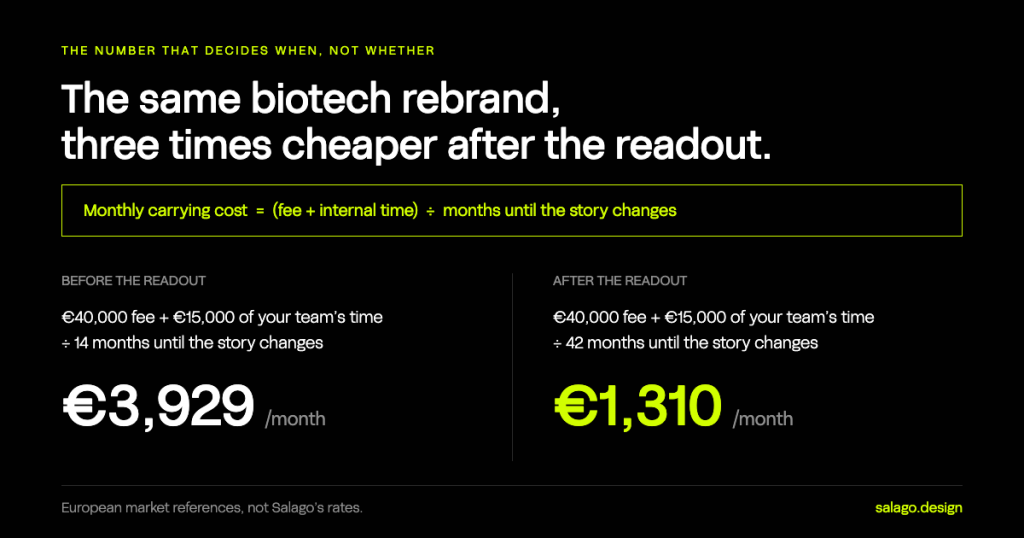
Monthly carrying cost = (quoted fee + internal time cost) ÷ months until the next milestone that would change the story
The internal time cost is the part no quote contains, and in life sciences it is larger than average, because the people who have to be in the room are the ones whose time is most expensive: the CSO, the CMO, the founder, the head of regulatory. Budget 60–150 hours of that seniority across interviews, workshops, claim review and asset migration. At a loaded €90–€150 per hour, that is €5,400 to €22,500 — a further 15–40% on top of the fee.
The milestone horizon is what makes this vertical different. Do not use “three to five years”. Use the next event that would force you to retell the story: a readout, a filing, a first commercial launch, a raise, an exit. If that event is eighteen months out, you are buying eighteen months of brand, and the arithmetic should say so.
| Monthly carrying cost | Rebrand before a readout | Rebrand after a readout |
|---|---|---|
| Quoted fee | €40,000 | €40,000 |
| Your team’s time (60–150 senior hours) | €15,000 | €15,000 |
| True cost | €55,000 | €55,000 |
| Months until the story changes again | 14 | 42 |
| Cost per month | €3,929 | €1,310 |
That is the whole argument for timing in one table. It is also why a studio that asks “what is your next milestone?” in the first call is worth more than one that asks for your budget.
How we approach it at Salago
We do not publish a rate card, for the reason set out at the top: the same word covers four different purchases and a single number would mislead more people than it helped. What we publish is the shape of the decision.
We scope after a diagnosis, not before one. The Brand Audit takes three to five days and exists to establish what you actually need — which, more often than the industry admits, is less than you came in for. From there: Clarity for positioning and narrative, Identity for the full verbal and visual system, and System when the rebrand has to reach a website, a congress and a sales conversation in the same cycle.
The work we are known for is the translation problem: taking something genuinely hard to explain and making it land with a non-specialist without losing what makes it true. That is what we did with GUA in biotech, and it is the same job in agtech and in climate — the science changes, the translation problem does not. What does change is who reads the brand: in agtech that is an agronomist rather than an investor, and it reorganises the whole project.
And the uncomfortable part, said out loud: if your positioning is settled and what you need is execution capacity, a production studio will do it faster and cheaper than we will. A strategic partner is worth paying for when “what do we say now” and “why us” are the open questions.
Frequently asked questions
Between €20,000 and €45,000 in 2026 for repositioning plus a new identity system, and €50,000 to €150,000 and above once a website and launch assets are included. Life sciences sits in the upper half of the general B2B range because the strategist has to absorb the science, claims go through review, and the asset list includes congress and publication materials that generic benchmarks leave out.
Twelve to sixteen weeks for positioning plus identity, and four to six months once a new website and launch assets are in scope. Sub-brands, several languages or a pipeline of programme brands push it to the upper end. The most common cause of delay is not the studio — it is the number of internal approvers and the number of claim review rounds.
It is worth it when the story has genuinely changed and the current brand contradicts it: after a pivot, a spin-out, a restructuring or the move from research to commercial. It is not worth it as a substitute for evidence. Early-stage biotech funding tightened in 2026 and investors are prioritising established data packages and nearer-term catalysts. If the round closes in under eight weeks, a positioning sprint and a rebuilt deck beat a full identity you cannot finish.
Renaming the company is a trademark exercise: screen, clear in your territories, register. Naming a medicinal product is a regulatory exercise — in Europe, invented names in the centralised procedure are reviewed by the EMA against safety-driven criteria, separately from trademark clearance. They are two budgets and usually two suppliers. A quote that merges them is not comparable to anyone else’s.
Budget 60 to 150 hours of senior internal time across interviews, workshops, claim review and asset migration — and in life sciences that time belongs to the most expensive people in the company. At a loaded €90–€150 per hour it adds €5,400 to €22,500 of real cost, or 15–40% on top of the fee. Ask any prospective studio how many hours of your team its process assumes; one that has never counted is telling you something.
Yes, and for most biotechs it is the better structure: diagnosis, then positioning, then identity, then rollout, with a decision point between each. Phasing costs 5–10% more in total because of re-onboarding between stages, and it removes the much larger risk of committing €50,000 to a direction nobody has validated. Insist that each phase ends with something usable on its own.
There is no honest evidence that it does on its own. Companies that rebrand and then raise well usually rebrand because they had news worth renaming around. What a rebrand can do is remove friction: fewer minutes spent explaining what you do, fewer investors who file you into the wrong category, a narrative your whole team tells the same way. Those are real, and they are not a valuation multiple.
Scientific poster and congress templates, figure and data-visualisation standards, publication-ready assets, an investor narrative that survives a technical audience, and a claims framework that survives regulatory or legal review. If a quote mentions none of these, it has been priced as a general B2B project and the gap will reappear later as change requests.
When the platform thesis is still moving and the category could change again within two quarters; when nobody has the authority to decide what the company will and will not claim; when the round closes in weeks; or when the real problem is thin data. In all four cases the money buys a more expensive version of an unresolved decision.
In short
€20,000 to €45,000 for positioning plus identity, €50,000 to €150,000 and up once the website is in. Life sciences sits in the upper half of the general market for reasons you can ask about, one by one. But the number that decides whether the money was well spent is not the fee — it is the fee plus your team’s hours, divided by the months until the next milestone that would change the story. Bought on the wrong side of a readout, the same project costs three times as much per month.
If you want the honest version of whether a rebrand is what you need right now, that is what the Brand Audit is for, or you can tell us where your brand stands and what the next milestone is and we will tell you what we would scope and why.
Related reading: how much a B2B branding project costs — the same arithmetic across all of B2B, with the full scope table. Consulting firm vs execution studio vs strategic design partner — who to buy this from. Brand positioning for B2B — what you are actually buying when you buy strategy. And the seven branding mistakes growing startups make.