
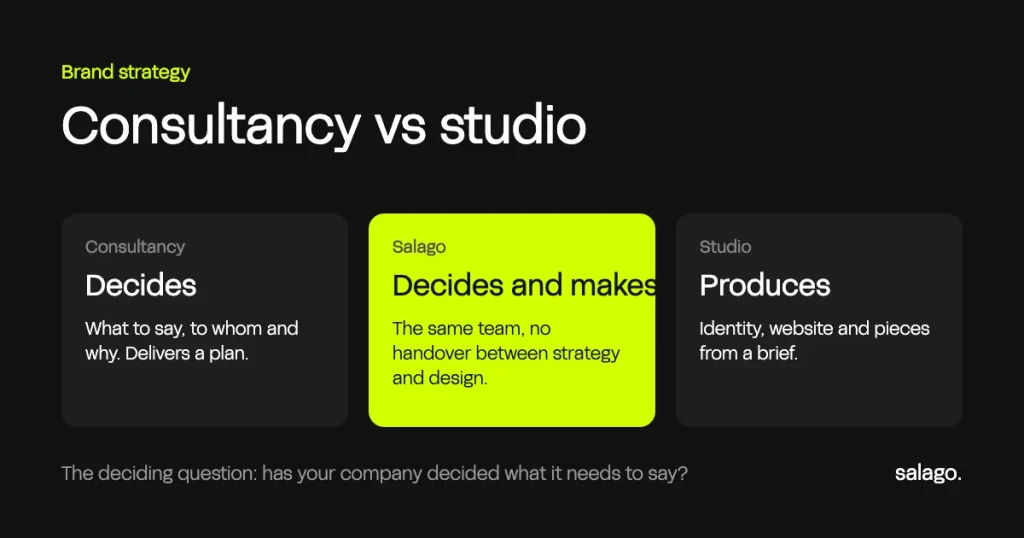
Quick answer. A consultancy helps you decide: what to say, to whom and why you. It delivers a diagnosis and a plan, and someone else does the execution. A design studio helps you produce: identity, website, decks and pieces, based on a brief the client usually writes. The choice depends on one question: has your company already decided what it needs to say? If it has, the problem is capacity and a studio is the fastest and cheapest option. If it has not, hiring a studio first means paying twice. And if you hire a consultancy, the risk lies in the handover: the strategy stays in a document nobody turns into a website or a sales deck. Salago sits between the two: it decides and produces within the same team.
What does a consultancy do?
A strategy or brand consultancy sells judgement. Its job is to understand the market, the customer and the competition, and turn that analysis into decisions: which customer to target, what promise to make, how to stand apart and what to stop doing. The usual deliverable is a document: diagnosis, positioning, message architecture and roadmap.
What a consultancy usually does not do is the execution. The identity, the website, the sales deck or the content are produced by the client’s in-house team or by a studio hired afterwards. That works well when the company has a marketing team able to translate a strategy document into pieces. When it does not, the document stays in a folder.
What does a design studio do?
A design studio sells craft. Its job is to produce, with quality and consistency, what the client needs: visual identity, website, decks, packaging, video or campaigns. It starts from a brief, some references and a direction that, in most cases, has already been set.
A good design studio greatly improves how a company looks and feels. What it cannot do well is decide for the client what it needs to say. If the brief is confusing, the studio produces very polished pieces on a confusing message, and the problem comes back as soon as the novelty wears off.
Consultancy vs studio: the comparison
| Dimension | Consultancy | Design studio | Salago (in between) |
|---|---|---|---|
| What it sells | Judgement and decisions | Craft and production | Decisions and their execution, in the same team |
| Main deliverable | Diagnosis, positioning and plan | Identity, website, pieces and materials | Positioning, identity, website and sales materials that are consistent with each other |
| Starting point | A business question | A brief | A business question that ends in its own brief |
| Who decides what to say | The consultancy, with leadership | The client, before starting | Salago with leadership, in working sessions |
| Usual risk | Strategy that never reaches the website or sales | Excellent design on an undecided message | It requires uncomfortable decisions: cutting, focusing, saying no |
| Fits when | Direction is missing and there is an in-house team to execute | Direction is clear and capacity or quality is missing | Direction is missing and nobody can turn it into pieces |
Where do projects get lost? In the handover
Most brand projects do not fail at strategy or at design, but in the step from one to the other. The consultancy delivers a document with well-reasoned positioning; months later, a studio receives that document as a brief, interprets it its own way and produces an identity and a website that only half resemble what was decided. Nobody does anything wrong, but the result does not hold.
The signs that the handover has failed are easy to recognise: the website says something different from what salespeople say in meetings, the sales deck is rebuilt for every opportunity and nobody has opened the strategy document since it was presented.
That is why the useful question is not “consultancy or studio” as a label, but who takes responsibility for the decision reaching the website, the deck and the sales conversation intact.
Which one does your company need?
A consultancy, if…
- The problem goes beyond the brand: pricing, organisation, entering a market or a corporate transaction.
- You have a strong in-house marketing team that can turn a document into pieces.
- You need an independent diagnosis for a board or for investors.
A design studio, if…
- Positioning and messages are decided and written down, and leadership and sales stand behind them.
- What is missing is visual quality, production volume or speed.
- You know exactly which pieces you need and by when.
A team in between, if…
- The product is good, but the market sees you as one more.
- Every salesperson explains the company differently.
- You have no in-house team to turn a strategy into a website, deck and content.
- You already paid for a strategy or a redesign and the problem is still there.
The three-question test
Before asking for quotes, answer these three questions in writing. Your answers decide which kind of supplier makes sense.
| Question | If the answer is yes | If the answer is no |
|---|---|---|
| 1. Can you write in one sentence what you do, for whom and why you, and do leadership and sales sign it off? | What to say is solved: go to question 3 | A decision is missing: consultancy or a team in between |
| 2. Is there someone in the company who can turn a strategy document into briefs for each piece? | A consultancy may be enough | You need whoever decides to also execute |
| 3. Do you know exactly which pieces are missing and by when? | A design studio is the most direct option | The problem is not production: go back to question 1 |
Where Salago sits
Salago sits between a consultancy and a studio. From the consultancy it takes the method: starting from a business question, understanding the market and the buyer, and forcing positioning decisions. From the studio it takes the craft: identity, website, motion and sales materials produced by the same team that made the decisions. The practical difference is that there is no handover: whoever decides what to say is whoever turns it into pieces.
Salago is not a business consultancy: we do not work on operations, finance or organisation, and we do not deliver a document for someone else to execute. Nor is it a production studio: we do not start designing on an undecided message. We work mostly with science and technology companies, where the product is technically good and commercially hard to explain, which is exactly where the cost of the handover shows most.
| Programme | Which part it covers | Timeline | Price |
|---|---|---|---|
| Brand Audit | Diagnosis: whether the problem is decision, execution or both | 3-5 days | 2,500 €, deducted if a programme is then hired |
| Clarity | The consultancy part: strategy and positioning | 2-3 weeks | 5,000 € |
| Identity | Decision plus visual and verbal identity | 6-8 weeks | From 15,000 € |
| System | The whole journey: strategy, identity, system and launch | 3-4 months | From 35,000 € |
The honest caveat: when we are not the best option
A team in between costs more per week than a production studio, because it includes decision hours a studio does not bill. If your company already knows exactly what it wants to say and only needs pieces, a good studio will be cheaper and will be the right purchase.
And if the problem is a business one and not a brand one —a pricing model that does not work, a reorganisation or entering a country— what you need is a business consultancy. The brand can wait until those decisions are made.
How to start
If you are not sure which side your problem is on, the starting point is a Brand Audit: in 3-5 days you know whether you need to decide, execute or both, and if you then hire a programme, the cost is deducted. If you already know the decision is missing, the programme is Clarity.
Frequently asked questions
A consultancy helps decide what a company needs to say, to whom and why, and delivers a diagnosis and a plan. A design studio produces the pieces, such as identity, website or decks, from a brief. The consultancy works on the decision and the studio on the execution.
It depends on whether the message is already decided. If the company knows what to say and leadership and sales stand behind it, a studio is faster and cheaper. If it does not know and has an in-house team to execute, a consultancy fits. If it does not know and has nobody to execute, it needs a team that does both.
Many studios offer strategy, just as many consultancies take part in execution. The difference is who takes responsibility for the decision reaching the website and sales intact. It is worth asking a supplier who makes the positioning decisions and who produces the pieces, and whether they are the same people.
It is the loss that happens when a consultancy delivers a strategy document and another team turns it into pieces. The studio interprets the document its own way and the result only half resembles what was decided. The signs are a website that says something different from what salespeople say and a strategy nobody opens again.
The diagnosis (Brand Audit) costs 2,500 € and is deducted if a programme is then hired. Strategy and positioning (Clarity) costs 5,000 €, strategy with full identity (Identity) starts at 15,000 €, and the full programme with system and launch (System) starts at 35,000 €, excluding taxes.
Neither on its own. Salago sits between a consultancy and a studio: it makes positioning decisions like a consultancy and produces the identity, website and sales materials like a studio, with the same team and no handover between one phase and the next.
When the company already has its message decided and only needs production, because a studio will be cheaper. And when the problem is a business one and not a brand one, such as pricing, organisation or entering a country: then the right choice is a business consultancy, and the brand can wait.
In short
A consultancy decides and a studio produces. Choosing between them depends on whether your company already knows what it needs to say: if it does, a studio; if it does not and has someone to execute, a consultancy.
The risk of separating them lies in the handover: strategy that never reaches the website or sales. If you have no in-house team to build that bridge, you need someone who decides and produces at the same time.
That is where Salago sits, between the consultancy and the studio. And to know which side your problem is on, answer the three questions: can you write in one sentence what you do, signed off by leadership and sales? Is there someone who can turn a strategy into briefs? Do you know which pieces are missing?
Keep reading: Redesign or brand system?, Brand positioning for B2B and how much B2B branding costs.