
Quick answer
Agtech branding costs the same as any other B2B project — €20,000 to €45,000 for positioning plus an identity system, €50,000 to €150,000 once a website and launch assets are in — but the job is structurally different, and getting that difference wrong is what makes the money disappear. In biotech the brand is read by an investor. In agtech it is read by an agronomist, and then repeated by that agronomist to a farmer who wants at least a 3:1 return and, half the time, is not willing to pay for the product at all. Three things follow: your claim has to survive a season in which the same product on the same field can give a different result; your proof is a trial, not a slide; and your real distribution channel is a technical adviser you do not employ. Budget the multi-market premium instead of biotech’s regulatory one — +30% to +100% once you cross languages, countries and crop portfolios. It is worth doing when you are being compared as a commodity input; it is not worth doing while your trial data still contradicts itself.
The price ranges in this article are European market references for 2026, taken from published agency pricing guides. They are market references, not Salago’s rates. The adoption and funding figures are cited to their sources in the text.
What an agtech rebrand costs in 2026
There is no separate “agtech rate”. The scopes and the ranges are the ones that apply across B2B — what changes is which line you land on and what pushes you along it.
| Scope | Market range (2026) | Typical duration | What moves it in agtech specifically |
|---|---|---|---|
| Brand diagnosis only | €2,500–€7,000 | 3–5 days | Nothing. Same work, same days. |
| Repositioning and narrative | €8,000–€30,000 | 2–4 weeks | Number of crops, geographies and channel tiers the story has to hold across. |
| Identity system | €10,000–€30,000 | 6–8 weeks | Packaging and label systems, which most B2B projects do not have. |
| Positioning + identity | €20,000–€45,000 | 12–16 weeks | Whether the claim needs trial data behind it before it can be written down. |
| Rebrand + website + launch assets | €50,000–€150,000+ | 4–6 months | Technical datasheets, trial reports, distributor toolkits, field-day materials. |
| Multi-market and multi-crop rollout | +30–100% | +4–8 weeks | The real agtech premium. Each language and each regulatory territory is another claim set. |
| Product or range naming | +€6,000–€25,000 | 3–6 weeks | Trademark clearance per territory, plus checking the name does not imply a claim you cannot make. |
Who actually reads your brand
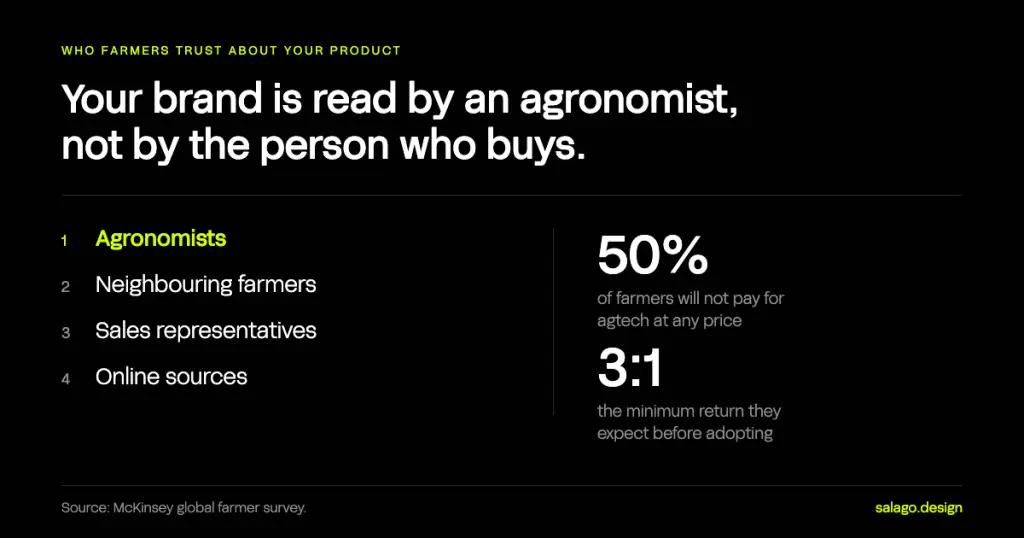
This is the finding that should reorganise an agtech marketing budget, and most companies act as if it were not true. When McKinsey asked farmers globally who they trust for information about agtech products, the ranking came out in this order: agronomists first, then neighbouring farmers, then sales representatives, then online sources. And fewer than 12% of farmers globally strongly prefer to buy online.
Read that as a distribution fact rather than a marketing one. The two most trusted channels — the independent adviser and the farmer down the road — are people you do not employ and cannot brief. Your brand does not reach the buyer directly. It reaches an agronomist, who compresses it into one sentence, and that sentence is what the farmer hears.
Which means the test for an agtech brand is not “is it compelling?”. It is: can an agronomist repeat it accurately in one sentence, from memory, without overclaiming? A positioning that only works when your own salesperson delivers it with a slide deck is a positioning that does not reach the market.
The adoption numbers you are branding against
It also helps to know how the room is sitting before you speak. The same research puts adoption at 61% in North America and Europe (currently using or planning to adopt within two years), 50% in South America and just 9% in Asia — and the split by farm size is starker than the split by geography.
| What the data says | Figure | What it means for the brand |
|---|---|---|
| Large farms (over 5,000 acres) adopting | 81% | Your early adopters are professionalised operations with someone whose job is evaluating inputs. Write for them. |
| Small farms (under 2,000 acres) adopting | 36% | Less than half the rate. If your growth plan assumes smallholders, the brand has to carry the risk argument, not the innovation one. |
| Farmers citing high cost as the top barrier | 47–52% | Price is the stated objection. It is almost never the real one — see the next row. |
| Farmers citing unclear return on investment | 30–40% | This is the real one. Not “too expensive”, but “I cannot tell what I get”. |
| European farmers citing setup complexity | 32% | A European-specific drag. Onboarding materials are brand work, not support work. |
| Farmers unwilling to pay for agtech at any price | 50% | Half the market is not a market. Positioning that ignores this is writing for an audience that does not exist. |
| Minimum return farmers expect before adopting | 3:1 | The number your proof has to clear. Not a differentiator — a threshold. |
Put the last two rows together and you get the honest brief for almost every agtech brand: you are not selling innovation to enthusiasts, you are selling a three-to-one return to a sceptic who would rather not spend anything. Very little agtech communication reads as if that were true.
The claim problem, which is worse in agtech than anywhere
In biotech a claim is constrained by a regulator. In agtech — particularly in biologicals, biostimulants and biofertilisers — it is constrained by something harder: the product does not behave the same way twice.
The industry says this plainly about itself. Temperature, light, soil chemistry and application timing all affect efficacy, to the point where a grower “can apply the same product to the same field at the same time of year and get different results”. On top of that there are no industry-standard definitions for the category, and companies are, in the words of one investor analysis, “cavalier with descriptions of their activities”.
That combination — variable performance plus undefined vocabulary — is why agtech marketing drifts toward the abstract. If you cannot promise the outcome reliably, it is tempting to promise something unfalsifiable instead. It is also why the market has learned to discount what it reads. Around 30% of growers who trialled biologicals decided not to roll them out at scale, and among US retailers surveyed, 52% held a positive attitude toward biostimulants and 23% an outright negative one. That negative quarter was not created by bad products. It was created by claims that did not survive contact with a field.
The way out is not a better adjective. It is a narrower claim with its conditions attached — which sounds like weaker marketing and performs like stronger marketing, because it is the only kind an agronomist will repeat.
| What agtech brands want to say | Why it fails | What survives a season |
|---|---|---|
| “Increases yield” | Unqualified, unfalsifiable, and contradicted the first time a trial comes back flat. | “+6–11% yield in trials on [crop] under [condition], across [n] sites and [n] seasons.” |
| “Improves soil health” | No agreed definition, so it cannot be verified or compared. | A named measurable: organic matter, water-holding capacity, microbial biomass — with the method. |
| “Sustainable” / “regenerative” | Category words with no shared meaning and rising scrutiny. | The specific input reduced, by how much, measured how. |
| “Works in all conditions” | Directly contradicted by the efficacy variability the category is known for. | The conditions where it works, said first — which is what makes the rest credible. |
| “Trusted by farmers” | Every competitor says it; carries no information. | A named cooperative, a region, a number of hectares. |
| “AI-powered” / “data-driven” | Describes your method, not the farmer’s outcome. | What decision it changes, and what that decision is worth per hectare. |
The uncomfortable part: writing the narrow version requires you to have the data. If your trials still contradict each other, no amount of brand work fixes that, and doing the brand work first will simply produce a beautifully designed claim you have to retract. That is the main reason to postpone.
When it is worth doing
The trigger is not age. It is the moment the market stops being able to tell you apart from a commodity input. Concretely —
- You are being compared on price per litre. The clearest signal that the category, not the product, is doing the deciding.
- You are entering a second country or a second crop. Each one is a new claim set and a new channel; a positioning built for one market silently breaks.
- You sell through distribution and the agronomists cannot explain you. If your channel partners describe you differently from each other, that is a positioning problem wearing a sales-enablement costume.
- You have trial data you are not using. The most common and most wasteful case: the evidence exists in a PDF nobody outside R&D has read.
- A portfolio that grew by accident. Products added over a decade with inconsistent names, so the range reads as a catalogue rather than a system.
When it is the wrong thing to buy
Agrifoodtech funding was flat at $16.2 billion in 2025, with deal count down 12%. Upstream — the farm-and-production side where most agtech sits — held up better at $9 billion, up 7%. But the composition changed: debt financing reached 18.2% of total agrifood funding, its highest share in a decade. That is a market financing operations rather than stories.
So hold off when —
- the trial data still contradicts itself between sites or seasons, in which case the money belongs in another season of trials;
- you have not decided whether you sell direct or through distribution, because those are two different brands and you cannot hedge;
- the range is about to change — rebranding a portfolio three months before you add or discontinue products means paying twice;
- the real problem is that the product needs a cold chain or an application window your channel cannot handle, which is an operations problem no brand solves.
The number to decide with
Same arithmetic as everywhere else, with one substitution that matters in this vertical.
Monthly carrying cost = (quoted fee + internal time cost) ÷ months until the story changes
In biotech, the horizon is the next readout. In agtech, the horizon is the campaign. You cannot launch a new brand into the middle of a season — the distributor’s catalogue is closed, the field days are booked, the labels are printed. If you miss the window, the work sits finished and unused until the next campaign, and you have paid for twelve months of brand while getting four.
| Monthly carrying cost | Landing before the campaign | Missing the window by one month |
|---|---|---|
| Quoted fee | €35,000 | €35,000 |
| Your team’s time (60–150 senior hours) | €12,000 | €12,000 |
| True cost | €47,000 | €47,000 |
| Months of use before the story changes | 36 | 25 |
| Cost per month of actual use | €1,306 | €1,880 |
This is why the first question worth asking an agtech studio is not about price. It is whether they will commit to a date that lands before your channel closes its catalogue, and what they cut if they cannot.
How we approach it at Salago
Agtech is the vertical where we have the most work behind us: Timac Agro in plant nutrition, Probelte in biological crop inputs, Norte Organics in organic production. Different companies, the same underlying job — a technically real product whose value is easy to overclaim and hard to explain in one sentence. The neighbouring case is impact-led companies, where the same overclaiming becomes illegal on 27 September 2026.
We scope after a diagnosis, not before one. The Brand Audit takes three to five days and, in agtech, usually spends most of that time on two questions: what can you actually claim with the evidence you have today, and what does your channel say about you when you are not in the room. From there: Clarity for positioning and the claim architecture, Identity for the verbal and visual system including packaging and labels, and System when it has to reach a website, a distributor toolkit and a field day in the same campaign.
And the uncomfortable part, said out loud: if what you need is a catalogue redesign and your positioning is settled, a production studio will do it faster and cheaper than we will. We are worth paying for when the claim itself is the problem.
Frequently asked questions
The same as any B2B project of the same scope: €20,000–€45,000 for positioning plus an identity system, and €50,000–€150,000 once a website and launch assets are included. Agtech does not carry biotech’s regulatory premium, but it carries a multi-market one — each additional language, country and crop portfolio adds 30% to 100%, because each is a separate claim set and a separate channel.
Because the person who reads your brand is not the person who buys. Farmers rank agronomists as their most trusted source of information, ahead of neighbouring farmers, sales representatives and online sources. Your positioning has to be repeatable in one sentence by an independent adviser you do not employ. If it only works when your own salesperson delivers it, it does not reach the market.
Narrow ones with their conditions attached. The category has no industry-standard definitions and efficacy genuinely varies — the same product on the same field at the same time of year can give different results. So “increases yield” fails and “+6–11% in trials on this crop under these conditions, across this many sites and seasons” survives. The narrow version is the only one an agronomist will repeat, because it is the only one that does not put their credibility at risk.
No. That is the clearest case for postponing. Brand work turns evidence into a claim; if the evidence is not stable, you will pay to design a claim you later have to retract, and the retraction costs more than the delay. Spend the money on another season of trials and do the brand work against data you can defend.
Before your channel closes its catalogue for the campaign. Distributor listings, field days and printed labels all have fixed windows, and missing them means the finished work sits unused until the next season. In practice that turns a €47,000 project into €1,880 per month of use instead of €1,306, without anything about the work changing.
One positioning, several proof sets. The category you compete in and the reason to believe you should hold everywhere; the trial data, the crops, the regulatory claims and often the product names will not. Companies that build a separate positioning per market end up with a portfolio nobody can summarise, which is the failure mode a rebrand is usually hired to fix.
Build the brand your channel can carry: one repeatable sentence, a claim with its conditions, comparison material that helps an agronomist justify the recommendation, and trial data presented so it can be shown rather than read. Fewer than 12% of farmers globally strongly prefer to buy online, so the digital brand mostly serves the adviser, not the buyer.
Agrifoodtech funding was flat at $16.2 billion in 2025 with deal count down 12%, though upstream held up better at $9 billion, up 7%. Debt reached 18.2% of agrifood funding, the highest share in a decade — a market financing operations rather than narratives. That argues for brand work tied to a commercial event you can point at, not brand work as a general investment.
Packaging and label systems, technical datasheets, trial-report templates, distributor and agronomist toolkits, field-day and trade-fair materials, and a claim architecture that states what may be said in each territory. If a quote mentions none of these, it has been priced as a generic B2B project and the gap will come back as change requests.
In short
Agtech branding costs what B2B branding costs. What is different is the job. Your brand is read by an agronomist and repeated to a sceptic who wants 3:1 and would rather not spend anything, about a product that may behave differently next season, in a category with no agreed vocabulary. The work that pays for itself is not a better adjective — it is a claim narrow enough to survive a field, with its conditions attached, that a technical adviser can repeat without risking their own credibility. And it has to land before the catalogue closes.
If you want the honest version of whether that is your problem right now, that is what the Brand Audit is for, or you can tell us what you can claim today and what your channel says about you and we will tell you what we would scope and why.
Related reading: Climate tech branding when nobody pays the green premium, where the same buyer refuses the premium your positioning assumes. how much a biotech rebrand costs — the same vertical logic where the gatekeeper is a regulator rather than an agronomist. How much a B2B branding project costs, with the full scope table. Consulting firm vs execution studio vs strategic design partner, on who to buy this from. And brand positioning for B2B.