

Short answer: climate tech branding stops working when it sells the mission instead of the substitution. Both ends of the market moved in 2025 and they moved in opposite directions. Investors put 40.5 billion dollars into climate tech across 18% fewer deals, with growth-stage investment up 78% while seed fell 20%. Industrial buyers went the other way: in a Fastmarkets survey of 23 European steel consumers, only around 20% would pay more than 75 dollars a tonne for lower-carbon steel, and none would pay more than 330. A brand that leads with the planet is talking to neither group. A brand that leads with the substitution — what it replaces, at what cost, for whom, with what proof — is talking to both.
The money did not leave. It changed shape
The most common misreading of the last two years is that climate tech funding collapsed. It did not. The total went up. What collapsed was the number of companies sharing it. That distinction matters for positioning, because a category with more money in fewer hands rewards a completely different kind of brand than a category with money spread thin.
| Measurement | 2025 | Direction vs 2024 | What it means for your brand |
|---|---|---|---|
| Venture and growth capital into climate tech | 40.5 bn USD | +8% | The category is not shrinking. Stop apologising for it in the first line. |
| Number of deals | 1,545 | -18%, lowest since 2020 | Fewer, larger bets. Making a shortlist matters more than being discoverable. |
| Seed investment | – | -20% | A story on its own no longer clears the first round. |
| Series A investment | – | -7% in value, -22% in deal count | The A is where positioning gets tested, and it got harder. |
| Growth-stage investment | – | +78% in value, +41% in deal count | Capital concentrates on companies that already read as infrastructure, not as a cause. |
| Series C investment | – | -32%, all-time low | The gap opens exactly where promise should have become proof. |
| Mega-deals framed around energy security and resilience | 7.2 bn of 10.1 bn USD | 6 of the top 10 deals | The winning frame is security, not virtue. |
Read the last row again. Six of the ten largest deals of the year were framed around energy security and resilience, and they carried 7.2 of the 10.1 billion dollars in mega-deal value. Those are not different companies from the ones that would have called themselves climate tech in 2021. In many cases they are the same companies with a different first sentence.
Europe is now the largest market, and the hardest one to measure
In the first quarter of 2026, Europe led the world in climate tech venture funding for the first time. It is also the quarter where two credible sources published numbers that look irreconcilable. They are not. They are measuring different things, and knowing which one your investor is quoting is worth more than any deck slide.
| Source | What it counts | Q1 2026 investment | Deals |
|---|---|---|---|
| PitchBook | Climate tech venture capital, Europe including the United Kingdom | 6.6 bn USD | 191 |
| Cleantech for Europe | Cleantech venture and growth equity, EU-27 only, debt excluded | 1.3 bn EUR | 62 |
Both readings agree on the shape underneath. On the PitchBook count, three deals alone carried 56.4% of Europe’s quarterly value. On the Cleantech for Europe count, 62 deals is the lowest quarterly figure since 2017, early-stage deals fell 25% in a single quarter, and late-stage deal count hit a five-year low. Concentration at the top, thinning at the bottom.
The geography is worth knowing if you are raising from Europe. In that quarter Germany closed 18 deals, France 12, the Netherlands 7 and Spain 6, with 16 of the 27 member states recording any cleantech venture activity at all. Energy and power took 62% of the money; transport and logistics 16%; waste and recycling 7%; resources, agrifood and materials 5% each. If you are outside energy and power, you are competing for the remaining third, which is another way of saying your positioning has to do more work, not less.
The vocabulary moved, and most websites did not
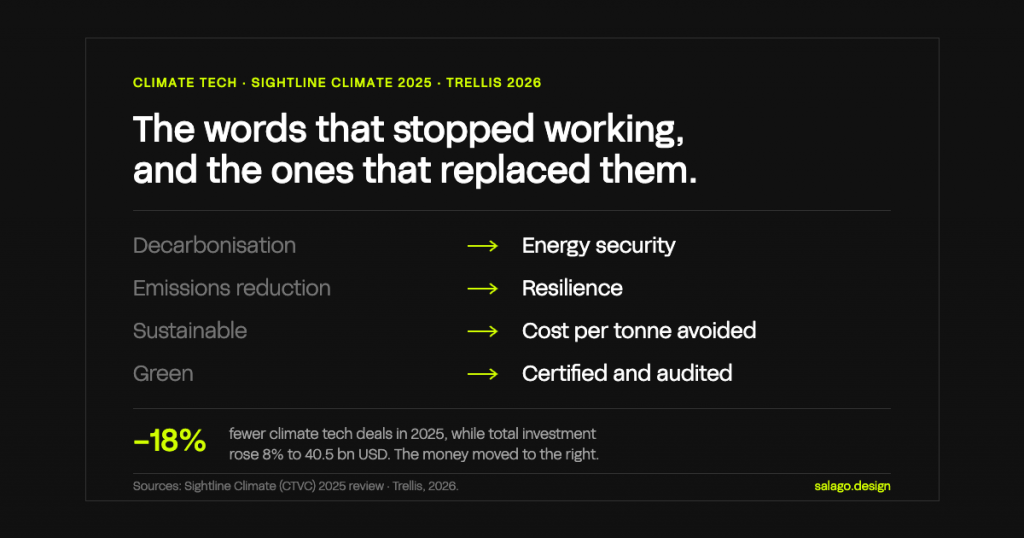
The clearest signal of 2025 was linguistic. Sightline Climate summarised the year by saying investment is now anchored to “electrons, not emissions”. Analysts at Trellis described the same shift in the words themselves: decarbonisation became energy security, emissions reduction became resilience. This is not spin. It is the market telling you which value it is actually paying for, and it is paying for cost, continuity and control.
| The word that stopped working | What replaced it | Who that language is for |
|---|---|---|
| Decarbonisation | Energy security | Investors and industrial boards |
| Emissions reduction | Resilience, continuity of supply | Operations and risk owners |
| Sustainable | Lower cost per unit, lower cost per tonne avoided | Procurement |
| Green | Certified, measured, auditable | Compliance, CBAM reporting, customers’ own reporting |
| Climate positive, eco-friendly, carbon neutral by offset | Nothing. These are on the banned list in the EU from 27 September 2026 | Nobody, and soon no one legally |
The buyer will not pay the green premium. Steel is the proof
Green steel is the cleanest test case in the economy, because it is a commodity with a published price, a published carbon intensity and a published premium. If a willingness to pay a green premium existed anywhere, it would show up there first. It has not.
| Market | What sellers ask | What buyers will actually pay |
|---|---|---|
| Europe, long-term contracts | 200-350 EUR per tonne | Signed by a small number of automotive buyers |
| Europe, weekly assessment, January 2026 | 100-170 EUR per tonne | Broadly stable through 2025 in a 120-180 EUR band |
| Europe, spot market | 50-100 EUR per tonne | Thin activity |
| Europe, survey of 23 steel consumers | – | Around 20% would pay more than 75 USD per tonne. None would pay more than 330 USD per tonne. |
| China | Around 140 USD per tonne of extra production cost | Around 20 USD per tonne |
| United States | – | No recognised premium since May 2024 |
The volume tells the same story. Certified premium green steel is somewhere between 4 and 6 million tonnes against world production of roughly 1,885 million tonnes: about a quarter of one percent. And the demand that does exist is not virtue. Fastmarkets attributes the European shift to regulation, specifically the Carbon Border Adjustment Mechanism, which forces definitions and separates early winners from laggards. Buyers are not buying lower carbon because it is good. They are buying it because a rule made their alternative expensive.
This is the single most useful thing a climate tech founder can internalise before writing a word of website copy. Your buyer’s willingness to pay is not driven by whether they believe you. It is driven by whether a regulation, a customer requirement or a cost line makes not switching worse than switching. Your brand’s job is to make that comparison fast, credible and easy to defend internally. Everything else is decoration.
Does this mean hiding the climate part?
No, and the distinction is worth being precise about, because half the sector has overcorrected. There is a difference between what you lead with and what you leave out.
The mission is why your best engineers took a pay cut to join, why your board tolerates a longer payback, and why a customer’s sustainability team becomes an internal ally when procurement stalls. Remove it and you lose a real asset. But the mission is not the reason a plant manager signs. It is the reason the plant manager’s colleague forwards your page to them.
So: lead with the substitution, keep the mission, and make sure the two are in the same sentence at least once. “We replace X, at Y cost per unit, and that removes Z tonnes” is a sentence that works on procurement, on the sustainability team and on an investment committee simultaneously. “We are decarbonising heavy industry” works on none of them, because it does not tell anyone what to do next.
There is now a legal edge to this as well. From 27 September 2026, Directive (EU) 2024/825 bans generic environmental claims without proof, offset-based carbon neutrality claims and several other families of statement that are currently common on climate tech websites. We wrote the detail up separately in what to change before 27 September 2026. The short version: the vague vocabulary is simultaneously unconvincing to your buyer, unattractive to your investor and about to be unlawful. Three reasons, one fix.
Five things to change on a climate tech brand, in order
- Name the substitution in the first line. Not the category, not the mission, not the technology. What does a customer stop buying when they start buying you? If your homepage does not answer that above the fold, nothing further down will be read.
- Put a number next to it. Cost per unit, cost per tonne avoided, payback in months, uptime, or the customer’s own metric. It does not have to be flattering. It has to be checkable. A number that a buyer can dispute is worth more than an adjective they cannot.
- Separate the three audiences instead of averaging them. An investor wants the market and the moat. A procurement lead wants the comparison against incumbent supply. A sustainability or compliance lead wants the methodology and the certification. One page trying to satisfy all three satisfies none. Three clear routes from the homepage cost less than one clever page.
- Move the proof up and the promise down. Pilots, offtake agreements, certifications, third-party measurement, named customers. In a market where Series C investment fell 32% to an all-time low, the companies that stall are the ones whose evidence never caught up with their story.
- Audit every environmental claim against the 2026 rules now, not in September. Generic terms, offset-based neutrality claims and unverified future commitments all have to go or acquire proof. Doing it early is a positioning upgrade. Doing it in a hurry is a legal exercise.
What this costs, and where to start
The realistic range for a climate tech company between Series A and Series B is the same as the rest of technical B2B, and we break the numbers down in how much B2B branding costs. What changes in climate tech is the sequence, not the price. Two constraints drive it.
The first is the funding shape above: with growth-stage capital up 78% and Series A deal counts down 22%, the pressure on positioning arrives earlier than founders expect. The second is the 27 September 2026 date, which puts a hard deadline on the claims layer regardless of where you are in your roadmap.
In practice that means starting with the argument rather than the visual system. A Brand Audit at 2,500 EUR over three to five days tells you which claims are exposed, which page loses the buyer and whether the substitution is legible at all. Clarity at a fixed 5,000 EUR over two to three weeks fixes the argument itself: the category sentence, the proof structure and the three audience routes. Only after that does an Identity from 15,000 EUR do work that lasts, because it is dressing a position that has already been tested rather than one that is still being guessed at.
How we work on this at Salago
Salago is a branding studio in Madrid working with companies in science, technology and impact. Most of our work sits in exactly this situation: a technically strong company whose buyer is industrial, whose value is real and whose website describes a mission instead of a substitution.
In agrifood and environmental work that has meant Timac Agro, Probelte, Norte Organics and Kynegos, where the buyer is an agronomist or an operations lead rather than a consumer, and where the claim has to survive a technical reader. In biotech, GUA, where the horizon is the next milestone rather than the next fiscal year. The pattern repeats: the companies that convert are not the ones with the most inspiring purpose, they are the ones whose value is legible to a sceptical specialist in under a minute.
We are a design studio, not a law firm or a certification body. Nothing here is legal advice, and the claims work we do is about clarity and evidence, not compliance sign-off. If your exposure is significant, have a lawyer read the final wording.
Related reading: branding for agtech, where the reader is not the buyer, what a biotech rebrand costs and when to do it, and what impact companies must change before 27 September 2026.
Frequently asked questions
Climate tech branding is the work of making a climate or energy technology legible and credible to the people who decide whether to buy it, fund it or approve it. In practice that means naming what the technology replaces, attaching a checkable number to the comparison and separating the routes for investors, procurement and compliance readers. It is not environmental storytelling, and in 2026 it is increasingly not environmental vocabulary either.
No, but it should stop leading with it. The mission is what attracts talent, sustains a longer payback and creates internal allies at customer companies, so removing it costs you a real asset. What it does not do is close a sale, because an industrial buyer signs on cost, continuity and risk. The workable structure is to lead with the substitution and keep the mission in the same sentence: what you replace, at what cost, and what that removes.
Because capital concentrated. In 2025 climate tech took 40.5 billion dollars in venture and growth capital, up 8% on 2024, but across 1,545 deals, an 18% drop and the lowest count since 2020. Growth-stage investment rose 78% while seed fell 20% and Series A deal counts fell 22%. More money reached fewer, later-stage companies, which raises the bar on how quickly a company has to read as infrastructure rather than as a promise.
Mostly not, on the evidence available. In a 2024 Fastmarkets survey of 23 European steel consumers, only around 20% would pay more than 75 dollars a tonne for lower-carbon steel and none would pay more than 330. Certified green steel is roughly a quarter of one percent of world output. In the United States there has been no recognised premium since May 2024. Where demand does exist in Europe, analysts attribute it to regulation such as CBAM rather than voluntary willingness to pay.
Directive (EU) 2024/825 becomes applicable across the European Union with no transition period, and it bans several families of environmental claim that are currently common: generic terms such as environmentally friendly or climate neutral without proof, carbon neutrality claims based on offsetting, and unverified commitments about future environmental performance. Penalties are set at a minimum of 4% of turnover in the member state concerned, or at least 2 million euros where turnover is unavailable. This is general information, not legal advice.
It should name the substitution and attach a number to it. A reader should be able to answer three questions without scrolling: what does a customer stop buying when they start buying you, what does that cost or save on their own metric, and who has already done it. Category statements such as decarbonising heavy industry fail this test because they give the reader nothing to do next.
The realistic range is the same as other technical B2B work: a Brand Audit at a fixed 2,500 euros over three to five days, Clarity at a fixed 5,000 euros over two to three weeks, an Identity from 15,000 euros over six to eight weeks, and a full System from 35,000 euros over three to four months. What differs in climate tech is the sequence rather than the price, because the claims layer now has a legal deadline attached to it.
Between three weeks and four months depending on scope. The argument itself, meaning the category sentence, the proof structure and the audience routes, can be resolved in two to three weeks. A full identity takes six to eight weeks and a complete system with digital delivery takes three to four months. If the driver is the September 2026 claims deadline, start with the audit and the argument, because those are the parts that carry the exposure.
The terms describe overlapping markets but they carry different measurement scopes, which matters when you quote figures. In the first quarter of 2026, PitchBook counted 6.6 billion dollars of climate tech venture capital across 191 deals in Europe including the United Kingdom, while Cleantech for Europe counted 1.3 billion euros across 62 deals in the EU-27 excluding debt. Neither is wrong. Before quoting a market size, check which definition, which geography and whether debt is included.