
Quick answer
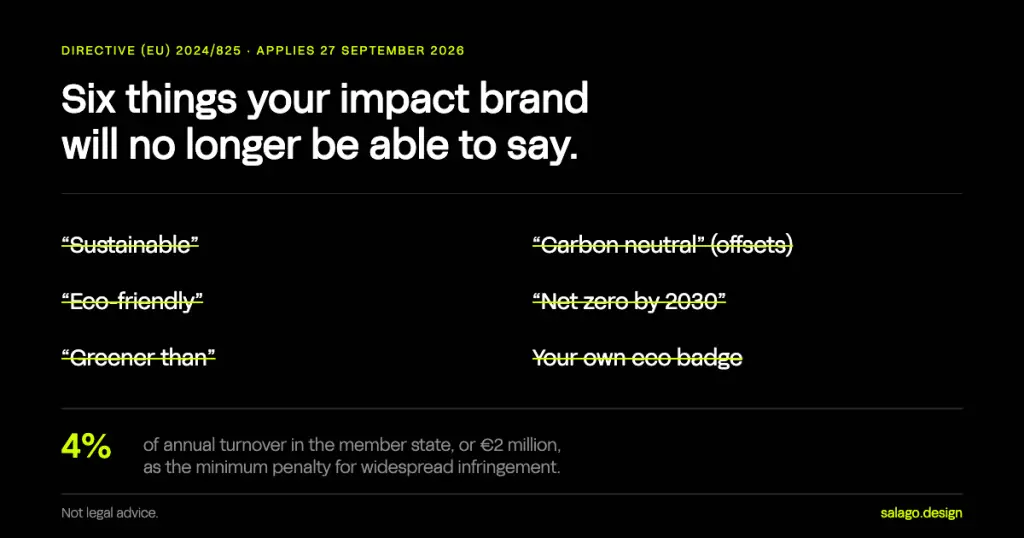
On 27 September 2026, the EU’s Empowering Consumers Directive (2024/825) becomes binding across the Union, with no transition period. From that date, a set of claims that appear on almost every impact-driven company’s website stop being allowed: generic environmental terms such as “eco-friendly”, “green” or “sustainable” without recognised certification or verifiable data; product-level carbon-neutrality claims based on offsetting; self-created sustainability badges that look like certifications; future pledges such as “net zero by 2030” without a published, monitored, independently verified plan; unverified recyclability; and comparative claims without a stated methodology. Penalties run to at least 4% of annual turnover in the member state, or €2 million. Courts have already been enforcing the substance under existing consumer law — TotalEnergies, FlixBus and Apple all lost in 2025. For a company whose value is impact, this is not a compliance chore. It is a repositioning deadline, because the words being banned are usually the words doing the positioning.
This article is written for founders and marketing leads, and it is not legal advice. The dates and prohibitions below are drawn from two independent regulatory summaries and are cited in the text; before changing or keeping a claim, have it reviewed by a lawyer who knows how your member state transposed the directive. Price ranges are European market references for 2026, not Salago’s rates.
What changes on 27 September 2026
Some context first, because there has been genuine confusion. The Green Claims Directive — the proposal that would have required environmental claims to be verified before publication — was withdrawn by the European Commission in June 2025. A lot of companies read that as a reprieve. It was the opposite of a reprieve: what was withdrawn was the procedure that would have told you in advance whether your claim was acceptable. The substantive bans were never in that directive. They are in Directive 2024/825, which member states had to transpose by 27 March 2026 and which applies EU-wide from 27 September 2026.
| What you probably say today | Status from 27 Sep 2026 | What can replace it |
|---|---|---|
| “Sustainable”, “green”, “eco-friendly”, “climate-friendly” | Banned as a generic claim unless backed by recognised certification or verifiable data | The specific effect, quantified: what is reduced, by how much, against what baseline, measured how. |
| “Carbon neutral” / “climate neutral” product, via offsetting | Banned at product level when it relies on offsets outside the value chain | Emissions actually reduced inside the value chain, stated separately from anything purchased. |
| Your own leaf icon or “eco” badge | Banned unless it comes from a third-party certification scheme with publicly accessible conditions | A real certification, or no badge at all and the number in words. |
| “Net zero by 2030” | Banned without a detailed, public, time-bound plan verified by an independent third party | The next milestone you can evidence, with the date and who checks it. |
| “Recyclable” | Banned without verified local recycling infrastructure | Where it is actually recyclable, named. |
| “Greener than”, “the most sustainable” | Banned without a published methodology and baseline | A comparison with its method attached, or no comparison. |
Read the right-hand column again. Every replacement is more specific and less flattering than what it replaces. That is the whole shift, and it is why this lands on the brand rather than on the legal team.
Why this is a positioning problem, not a compliance one
The instinct is to hand the list to legal, strike the offending words and move on. That produces a website with holes in it, because for most impact companies the banned words were carrying the differentiation. Remove “sustainable” from a page built on the word “sustainable” and what remains is a description of a product that now sounds like everybody else’s.
There is a second, less obvious consequence. If generic environmental language stops being available to everyone at once, then the companies that can be specific gain a differentiator they did not have before. Until now, a company with real measured outcomes and a company with a nice adjective looked broadly similar on a homepage. From September they will not. That is the opportunity buried inside the deadline, and it goes to whoever did the work of measuring.
The harder problem underneath
Regulation is the deadline, but it is not the actual difficulty. The actual difficulty is older and structural: in an impact company the value does not fit in the spreadsheet the buyer uses to decide.
A biotech has a readout. An agtech has a yield trial. An impact-driven business often has an outcome that is real, verifiable and genuinely valuable — water not used, soil not degraded, waste not created, a supply chain that does not exploit anyone — and none of it appears as a line in the purchase decision of the person signing. The buyer is asked to pay a premium for an absence.
That is why so much impact communication reaches for feeling: when you cannot put the value in the model, you try to put it in the mood. It is an understandable move and it is now also a regulated one. The alternative is harder and works better — find the version of the impact that does show up in the buyer’s own numbers, and lead with that, with the ethical argument standing behind it rather than in front of it.
| The impact you deliver | How it usually gets said | The version that enters the buyer’s model |
|---|---|---|
| Lower resource use | “Sustainable by design” | Cost per unit of input avoided, at their volumes. |
| Regulatory exposure reduced | “Future-proof” | Which specific obligation it anticipates, and what non-compliance costs. |
| Supply chain that holds up to scrutiny | “Ethical sourcing” | Audit and traceability their own customers will demand, already done. |
| Longer product life | “Circular” | Replacement cycle extended by n years, so the annualised cost falls. |
| Better outcomes for people | “Purpose-driven” | Retention, absenteeism, adoption — whichever one they already report on. |
| Lower emissions in the value chain | “Carbon neutral” | The reduction inside scope 1–3 that their own reporting has to absorb. |
The honest caveat: this reframing only works if you have measured. If the impact is real but undocumented, the work to do first is measurement, not messaging — and no brand project should pretend otherwise.
Three companies that already lost
The directive applies from September, but courts have been reaching the same conclusions under existing consumer law for a year, which is the clearest signal of where enforcement is heading.
- TotalEnergies — the Paris tribunal ordered the removal of carbon-neutrality marketing in October 2025, with a €10,000 per day penalty for non-compliance.
- FlixBus — the German Federal Court ruled in February 2025 against “klimaneutral” messaging that was not substantiated in the same medium where the claim appeared.
- Apple — barred in Frankfurt in 2025 from describing the Apple Watch as carbon neutral in Germany.
Three very large companies with very large legal departments. The lesson is not that they were careless; it is that the claim itself was the problem, and no amount of legal review rescues a claim that cannot be substantiated. Which is exactly why this belongs in the brand conversation, before it is written, rather than in the review that happens after.
What it costs to fix
There is no separate “impact rate”. What varies is how much of the brand was resting on the words that are going away.
| Situation | What it takes | Market range (2026) | Time |
|---|---|---|---|
| The claims are decoration, the positioning stands without them | Claims audit and rewrite of the affected copy | €2,500–€8,000 | 1–2 weeks |
| Some pages are built on generic claims | Claims audit plus messaging rework and new proof hierarchy | €8,000–€30,000 | 2–4 weeks |
| The positioning itself is the banned word | Repositioning: category, claim architecture, proof | €20,000–€45,000 | 12–16 weeks |
| Self-made eco badges are in packaging and labels | The above plus identity and packaging rework | €50,000–€150,000+ | 4–6 months |
| Several markets, each with its own transposition | Add a claim set per territory | +30–100% | +4–8 weeks |
Note the asymmetry in that table. Finding out which row you are on costs a few days. Assuming you are on the first row and discovering in October that you were on the third is what makes it expensive.
When to act and when not to
Act now if any of these is true: your homepage headline contains a word from the banned list; you use an own-brand eco badge; you make a product-level carbon-neutral claim; you have a public net-zero pledge without a verified, published plan; or you sell into more than one member state, since transposition differs and the strictest one sets your practical limit.
Do not act yet if your impact is real but unmeasured. In that case the money belongs in measurement and verification first — a repositioning built on numbers you cannot evidence recreates the same problem with better typography, and does it after the deadline rather than before.
How we approach it at Salago
We have built brands whose value is impact — Kynegos, which did not fit any of the available labels, and Norte Organics in organic production. In both cases the work was the same: find the version of the claim that is narrow enough to be true, specific enough to be checked, and still worth reading.
For this deadline specifically, the Brand Audit is the right first step and takes three to five days: an inventory of every claim you currently make, sorted into what survives September, what needs evidence you already have, and what has to be replaced. That inventory is useful whatever you decide next, and it is what tells you which row of the table above you are on. From there, Clarity if the positioning has to be rebuilt, Identity if badges and packaging are affected, and System when it has to reach the website, the deck and the sales conversation before the date.
And the uncomfortable part: we are a design studio, not a law firm. We can tell you which claims are doing the positioning work and how to replace them without losing the argument. Whether a specific sentence is compliant in your member state is a question for a lawyer, and we would rather say that than pretend otherwise.
Frequently asked questions
Directive (EU) 2024/825, the Empowering Consumers Directive, becomes binding EU-wide with no transition period. It bans generic environmental claims such as “eco-friendly”, “green” or “sustainable” without recognised certification or verifiable data; product-level carbon-neutrality claims based on offsetting outside the value chain; self-created sustainability badges; future pledges without a published, monitored, independently verified plan; unverified recyclability claims; and comparisons without a stated methodology.
Yes, in June 2025 — and it changed less than people assume. The withdrawn proposal was the procedural one, which would have let you have a claim verified before publishing it. The substantive bans live in Directive 2024/825, which was already adopted and applies from 27 September 2026. In practice the withdrawal removed the safety net, not the rules.
Member states must provide penalties of at least 4% of the trader’s annual turnover in the member state concerned, or at least €2 million where turnover cannot be established, for widespread infringements. Enforcement also includes injunctions, and in some member states revenue confiscation and exclusion from public procurement.
Not as a bare claim. “Sustainable” used generically requires recognised certification or verifiable data demonstrating excellent environmental performance relevant to the claim. What replaces it is the specific effect quantified: what is reduced, by how much, against which baseline, measured how. In practice that is a stronger sentence anyway, because everyone else has just lost the adjective.
Only if it comes from a certification scheme with third-party verification and publicly accessible conditions. Own-brand leaf icons and badges that imply official certification are prohibited. If you have one on packaging, that is an identity and print project, not a copy change, and it needs more lead time than the website does.
Only with a detailed implementation plan that is public, has measurable time-bound targets, and is verified by an independent third-party expert whose findings are also public. A pledge without that behind it is prohibited as a future-performance claim.
The directive amends consumer-protection law, so consumer-facing claims are the clearest exposure. But B2B companies in impact sectors are affected in two ways: their own consumer-facing communication, and their customers, who now need substantiated inputs to make their own claims. If you sell into a brand that has to comply, your evidence becomes part of their compliance.
A claims audit takes three to five days and tells you the scale. Rewriting affected copy is one to two weeks. A full repositioning, when the banned word was the positioning, is twelve to sixteen weeks — which is why the audit is worth doing now rather than in September.
No. It is written for founders and marketing leads and summarises publicly available regulatory analyses so you know which questions to ask. Transposition differs by member state, and whether a specific claim is compliant is a question for a lawyer.
In short
From 27 September 2026 the vocabulary most impact companies use to describe themselves stops being available. The right reaction is not to delete the words and hope the page still stands up — it is to notice that the words were doing the positioning, and to replace them with the version of your impact that shows up in the buyer’s own numbers. That version was always the stronger argument; the deadline just removes the easier alternative. And when generic language disappears for everyone at once, specificity becomes a differentiator for the companies that measured.
The cheapest useful next step is an inventory of what you currently claim, sorted by what survives. That is what the Brand Audit does in three to five days, or you can send us your homepage and the claims you rely on and we will tell you which row of that table you are on.
Related reading: Climate tech branding when nobody pays the green premium, where the same buyer refuses the premium your positioning assumes. branding for agtech, where the constraint is a field rather than a regulator. How much a biotech rebrand costs, where it is the EMA. How much a B2B branding project costs, with the full scope table. And brand positioning for B2B.