
Quick answer
In 2026, a B2B branding project from a European studio typically costs between €8,000 and €50,000, and where you land inside that range depends almost entirely on which of five separate things you are buying. Positioning and strategy on its own runs roughly €8,000–€30,000; a visual and verbal identity system, €10,000–€30,000; the two together — the most common B2B purchase — €20,000–€50,000; and a full brand system including a new website and launch assets, €50,000–€120,000 and up. Behind those numbers, senior European studios bill at about €80–€140 per hour or €500–€900 per day. But the quoted fee is not the cost: a strategy-plus-identity project also consumes 60–150 hours of your own senior team’s time, which adds 15–40% that never appears on an invoice. The number worth comparing between two proposals is not the quote — it is the quote plus your internal hours, divided by the number of months the brand actually has to survive.
Figures in this article are European and international market references for 2026, gathered from published agency pricing guides and Clutch’s verified client data. They are market references, not Salago’s rates.
Why almost nobody publishes a price for branding
Searching for the cost of a B2B branding project returns a wall of pages that say “it depends” and then ask you to book a call. That is frustrating, and it is also not entirely bad faith. The word “branding” covers at least five distinct purchases — research, positioning, naming, identity design, and rollout — and a studio that publishes one number will be compared against a quote that includes half of what theirs does.
The problem is that the vagueness pushes the whole decision into a sales conversation, where the buyer has no reference points. A technical founder who can price a mass spectrometer to the euro is asked to evaluate a €40,000 proposal with nothing to anchor it against. So here are the anchors, followed by the method for comparing two quotes that look nothing alike.
The five things people mean by “branding”
Before any number is useful, it helps to separate what is actually being bought. Most disagreements about price are really disagreements about scope.
- Diagnosis. An audit of what your brand currently says, what the market hears, and where the gap is. Days of work, not weeks.
- Positioning and strategy. The decisions: which category you are in, who you are for, what you claim, what you refuse to claim, and the messaging architecture that follows.
- Naming. A new company, product or platform name, plus trademark screening. Frequently needed in deep tech after a pivot or a spin-out, and priced separately for good reason.
- Identity. The visual and verbal system — mark, typography, colour, motion, tone of voice — plus the guidelines and templates that let your team use it without calling anyone.
- Rollout. Website, decks, data sheets, conference materials, signage, video. This is where budgets quietly double.
A quote for €12,000 and a quote for €45,000 are often both fair. One is buying items 4 alone; the other is buying 1, 2 and 4 with part of 5. The comparison only becomes possible once you know which is which.
What B2B branding costs in 2026
The table below gives market reference ranges by scope. The last column is the one worth reading twice: it is the question that stops two very different proposals from being compared on price alone.
| Scope | Market range (2026) | Typical duration | The question to ask before signing |
|---|---|---|---|
| Brand audit / diagnosis only | €2,500–€7,000 | 3–5 days | Does the fee get credited against the project if we go ahead? |
| Positioning and strategy | €8,000–€30,000 | 2–4 weeks | What do we receive that a new hire could act on without you in the room? |
| Identity system (no strategy) | €10,000–€30,000 | 6–8 weeks | Which positioning are you designing against, and who decided it? |
| Strategy + identity (most common B2B purchase) | €20,000–€50,000 | 2–3 months | How many hours of our team’s time does this assume? |
| Full brand system incl. website and launch | €50,000–€120,000+ | 3–6 months | Can you split the brand fee and the web fee into two numbers? |
| Naming + trademark screening (add-on) | €6,000–€25,000 | 3–6 weeks | Is legal clearance included, and for which territories? |
| Ongoing brand partner (retainer) | €3,000–€9,000/month | 3-month minimum | What happens to the retainer in a month when we ask for nothing? |
One number from that research deserves its own sentence, because it is the most commonly misused statistic in this category. Clutch’s verified client data puts the mean branding project at roughly €66,000 delivered over about eight months. That average is real, and it is also almost useless as a budget: it is pulled upwards by enterprise rebrands with multi-market rollouts, and the median B2B engagement sits far below it. If someone quotes you an industry average, ask what the median was.
What makes the same scope cost twice as much
Two studios can quote the same deliverables and differ by a factor of two without either of them being wrong. These are the variables that move the number, in rough order of how much they move it.
| Cost driver | Effect on the fee | Why it moves the price |
|---|---|---|
| Primary research (interviews, market study) | +€5,000–€20,000 | Interviewing twelve customers and four analysts is weeks of senior time, and it is the line most often cut to win a pitch. |
| Number of decision-makers | +20–50% | Each additional approver adds review rounds. Five founders with equal say is the single most expensive condition in branding. |
| Naming and trademark clearance | +€6,000–€25,000 | Most candidate names fail legal screening. The cost is in the failures, not the winner. |
| Number of sub-brands, products or markets | +30–100% | A brand architecture with four product lines and two languages is not one identity, it is a system with rules. |
| Seniority actually doing the work | ±40% | A cheap quote often means a junior team with senior supervision. Ask who runs the workshops. |
| Compressed timeline | +15–30% | Anchoring delivery to a conference date or a closing round means parallel work and overtime. |
| Volume of existing assets to migrate | +€3,000–€15,000 | Every legacy deck, data sheet and trade-show panel has to be rebuilt by someone. |
Why biotech, agtech and deep tech sit at the top of the range
Branding a deep tech company costs more than the generic benchmarks suggest, and the reasons are specific rather than a premium for the sector name.
If that is your case, there is a version of this article written for the vertical: how much a biotech rebrand costs, and when it is worth it — with the life-science cost drivers broken out one by one, and the timing test that decides whether to do it before or after your next readout.
The strategist has to learn the science. Writing a positioning statement for a biostimulant, a cell therapy platform or a photonic sensing stack requires understanding the mechanism well enough to know which claims are load-bearing and which are marketing. That absorption is typically 10–25 hours that a consumer brand project never spends, and skipping it produces the copy that makes your own scientists wince.
Two audiences want opposite things. Investors want the category, the market size and the inevitability of the story. Technical buyers and scientific reviewers want the data, and they punish overclaiming immediately and permanently. One identity has to carry both registers without either audience feeling they are being sold the other one’s version.
Regulated claims add review rounds. What you may say about a therapeutic, a crop input or a diagnostic is constrained, and every constraint means another pass through legal or regulatory affairs. Budget review rounds accordingly, and get regulatory into the kick-off rather than the final approval.
The asset list is unusual. Deep tech brands need things the generic benchmark never included: scientific poster templates, conference booth systems, data visualisation rules, mechanism-of-action animation, figure standards for papers, and investor decks that survive being forwarded without you. That is rollout work, and it belongs in the budget from the start.
There is also a timing pattern worth naming. In biotech, rebrands cluster around pivots, restructurings and spin-outs — moments when the story genuinely changed. The market does respond to them: Labiotech has documented cases where shares moved sharply on a rebrand announcement. But the honest reading of those same cases is the one an executive quoted in that piece gave: a rebrand cannot solve an underlying problem, and investors still look for clinical progress and revenue. A new name buys attention, not evidence.
The number to compare quotes with
Comparing two branding proposals on their headline fee is the single most common budgeting mistake in B2B, because the headline fee excludes the two things that determine whether the money was well spent: your own time, and how long the result lasts.
Use this instead.
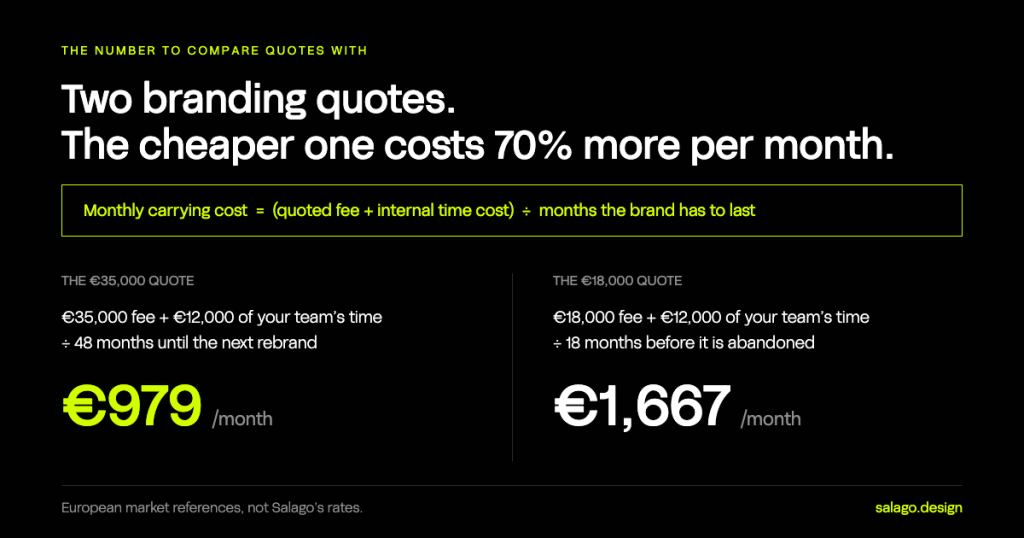
Monthly carrying cost = (quoted fee + internal time cost) ÷ months the brand has to survive
Internal time cost is the part nobody quotes. A strategy-plus-identity project consumes 60–150 hours of senior internal time — founder, CSO, CTO, head of communications — across interviews, workshops, reviews and asset migration. At a loaded cost of €90–€150 per hour, that is €5,400 to €22,500 of real expense, or 15–40% on top of the fee. Ask any prospective studio how many hours of your team’s time their process assumes. A studio that has never counted is telling you something.
Months the brand has to survive is the horizon until you would realistically do this again. In deep tech that is rarely a round number of years; it is pinned to a milestone — the next raise, first commercial launch, regulatory approval, an exit. Three to five years is typical.
The arithmetic is unforgiving in a useful way. A €35,000 proposal plus €12,000 of internal time is €47,000; spread over 48 months, that is €979 per month. A €18,000 proposal that produces something the board quietly abandons before the Series B is €18,000 plus the same €12,000 of internal time — because the cheap project consumes just as much of your team — over 18 months: €1,667 per month. The cheaper quote costs 70% more per month, and you go through the process twice.
| Monthly carrying cost | The €35,000 proposal | The €18,000 proposal |
|---|---|---|
| Quoted fee | €35,000 | €18,000 |
| Your team’s time (60–150 senior hours at €90–€150/h) | €12,000 | €12,000 |
| True cost | €47,000 | €30,000 |
| Months before you do this again | 48 | 18 |
| Cost per month | €979 | €1,667 |
The second number almost nobody calculates
Divide the true cost by the number of assets your own team can produce in the first year without calling the agency again. This is the metric that separates a brand system from a logo, and in deep tech it is decisive, because these teams produce a relentless volume of material: conference posters, congress booths, investor updates, application notes, paper figures, webinar decks.
A €45,000 system that ships editable templates, a documented type and colour scale, and rules a non-designer can follow might support 150–250 internally produced assets in year one. A €18,000 identity delivered as a PDF of guidelines and three logo files supports almost none — every poster becomes a new invoice. Per asset, the expensive option is an order of magnitude cheaper. When you review a proposal, count what ships as editable, not what ships as beautiful.
How to read a branding quote
Most proposals are written to be persuasive rather than comparable. These are the phrases worth interrogating, and what to ask when you see them.
| What the proposal says | What it often means | What to ask |
|---|---|---|
| “Logo design — three concepts” | Priced as production, with no strategy underneath | What decision does concept two make that concept one doesn’t? |
| “Unlimited revisions” | Either the fee is padded upfront, or scope will be defended later | How many review rounds are budgeted, and what happens at round four? |
| “Brand guidelines delivered” | A PDF your team cannot actually work from | What ships as editable files and templates, and for which tools? |
| Brand and website as a single line item | Impossible to benchmark against anyone else | Can you split this into two figures with two scopes? |
| A quote 40% below every other one | They scoped something genuinely different | Which of the five purchases is not in here? |
| No named team, no hours, no day rate | The work may be subcontracted or run by juniors | Who personally runs the strategy sessions, and at what rate? |
| A number given before any diagnosis | The price is a guess that will be revised | What are you assuming about our internal time and approvers? |
How we price at Salago
We do not publish a rate card, for the reason set out at the top of this article: the same word covers five different purchases, and a single number would mislead more people than it helped. What we do publish is the shape of the decision. Our project enquiry form asks for an investment range with brackets running from under €8,000 to over €50,000, because that bracket is the fastest way for both sides to find out whether the conversation is worth having.
We scope after a diagnosis, not before one. The Brand Audit is three to five days and exists to establish what you actually need — sometimes that is less than you came in for. From there the programmes map onto the scopes in the table above: Clarity for positioning and strategy in two to three weeks, Identity for the full verbal and visual system in six to eight weeks, System for strategy through to launch across three to four months, and Growth as a monthly partnership with a three-month minimum.
The uncomfortable part, said plainly: for some companies at pre-seed or early seed, a branding project is the wrong purchase this quarter. If the product is still moving weekly and the category is unsettled, an audit and a sharper set of positioning decisions will do more than an identity system you will redo in a year. That is a worse outcome for our revenue and a better one for yours, and it is why the audit exists as a separate, cheap first step.
Frequently asked questions
Between €8,000 and €50,000 for most European B2B engagements in 2026, with full brand systems including a website running from €50,000 to €120,000 and above. The main variable is scope: strategy alone, identity alone, both together, or both plus rollout. Naming and primary research are the two add-ons that most often push a project into the next bracket.
Roughly €8,000–€30,000 for a positioning and messaging engagement without any design deliverables, typically over two to four weeks. The spread is driven almost entirely by research depth: a strategy built from internal workshops sits at the bottom of the range, one built from twelve customer interviews and a competitive audit sits at the top. Ask what you receive that a new hire could act on without the agency in the room.
Partly because “branding” covers five different purchases and one published number gets compared against quotes that include half of what it does. Partly because agencies price on complexity — approvers, sub-brands, markets, research — which cannot be known before a conversation. The reasonable middle ground, and the one to look for, is a studio that publishes investment brackets and scopes properly after a short paid diagnosis.
A positioning engagement takes two to four weeks, a full identity system six to eight weeks, and a complete brand system with a new website three to six months. Clutch’s verified data puts the average branding engagement at about eight months, but that figure is inflated by enterprise rollouts. The most common cause of delay is not the studio, it is the number of internal approvers.
A rebrand before a funding round is worth it when the story has genuinely changed and the current brand actively contradicts it — after a pivot, a spin-out or a shift from research to commercial. It is not worth it as a substitute for evidence: investors respond to a clearer narrative but still underwrite clinical progress, traction and revenue. If the round closes in under eight weeks, a positioning sprint and a rebuilt deck will do more than a full identity project you cannot finish in time.
A logo is one asset; a brand identity is a system that lets people who are not designers produce hundreds of assets correctly. The gap between €2,000 and €25,000 is not drawing quality, it is the type scale, colour rules, layout grids, motion behaviour, tone of voice and editable templates that come with the second one. If your team produces conference posters and investor decks every month, the system pays for itself in production time alone.
Yes, and in most cases it is the better structure: audit, then strategy, then identity, then rollout, with a decision point between each. Phasing costs slightly more in total because of re-onboarding between stages, usually 5–10%, and it removes the much larger risk of committing €50,000 to a direction nobody has validated. Insist that each phase ends with something usable on its own.
Expect the upper half of the general ranges — commonly €30,000–€60,000 for strategy plus identity — for four reasons: the strategist has to absorb the science, the work must satisfy investors and technical buyers simultaneously, regulated claims add review rounds, and the asset list includes scientific posters, congress materials and figure standards that generic benchmarks omit. Deep tech projects also tend to be pinned to external dates such as a conference or a closing round, and compressed timelines add 15–30%.
When the product is still changing weekly, when the category has not been chosen, when the real problem is a sales process rather than a story, or when there is no one internally with the authority to approve a direction. In those situations a project produces a beautiful artefact that gets quietly abandoned, and you pay again eighteen months later. A short paid audit will tell you which situation you are in for a fraction of the cost.
In short
A B2B branding project in 2026 costs between €8,000 and €50,000 for most European engagements, and €50,000 to €120,000 and above once a website and full rollout are included. Where you land is a function of scope, research depth, number of approvers and whether naming is involved — not of how good the studio is at design.
Compare proposals on the monthly carrying cost, not the headline fee: the quoted price plus your own team’s 60–150 hours, divided by the number of months the brand has to survive before the next milestone. A €35,000 project that lasts four years costs about €979 a month. An €18,000 project that gets replaced in eighteen costs €1,667 a month and burns the same amount of your time twice.
Then ask the second question, the one almost nobody asks: how many assets can our own team produce next year without calling anyone? In biotech, agtech and deep tech — where the output is a constant stream of posters, decks, application notes and congress materials — that number decides whether you bought a system or a logo.
If you want the honest version of which of the five purchases you actually need, that is what the Brand Audit is for, or you can tell us where your brand stands today and what you are working towards and we will tell you what we would scope and why.
Related reading: Consulting firm vs execution studio vs strategic design partner: what to choose (and why) — the same decision, viewed from the supplier side rather than the budget side. And Brand positioning for B2B: a practical framework to differentiate yourself, if the positioning phase is where you are. And the seven branding mistakes growing startups make — the reasons a project gets abandoned before it has paid for itself.