

Why Write This (and Why Now)
There’s a recurring symptom among SaaS B2B founders and CMOs with strong products: sales conversations drag on, outbound efforts fail to resonate, the website sounds correct but lacks impact, and the market compares you as if you were interchangeable.
The usual solutions are often suggested: a better copy, more campaigns, a better design, or another iteration of the pitch.
Sometimes these help. But the bottleneck is rarely there.
The real problem is more uncomfortable: you haven’t made (or clearly articulated) a positioning decision. You haven’t precisely decided where you compete, who you serve, why customers should choose you, and what evidence supports that choice.
In a world where execution is accelerating through AI, automation, templates, and playbooks, the advantage no longer comes from doing more. It comes from thinking more clearly and communicating what you truly do and why it matters.
Growth Isn’t “More Marketing”: It’s Less Friction, More System
In SaaS B2B, growth almost always comes down to the same thing: reducing friction and increasing trust at every stage of the go-to-market process.
That’s why branding, when done properly, isn’t aesthetics. It’s an operating system that aligns the entire team so they can execute consistently without reinventing the pitch every week.
Brand as an Operating System (Brand OS)
Think of your brand as a layer that standardizes decisions across five areas where growth is either won or lost:
- Category: The box people place you in—and who they compare you against.
- Narrative: The story that helps buyers understand why now matters.
- Messaging: Three to five repeatable arguments used across marketing, sales, and product.
- Proof: Accumulated evidence such as case studies, metrics, credentials, and authority.
- System: How positioning is applied across your website, sales deck, demos, outbound efforts, hiring, and partnerships.
When this operating system exists, two things happen: sales cycles shorten because there is less uncertainty and the perceived value increases because there is more trust.
The Uncomfortable Truth About B2B: People Buy Under Risk
In B2B, purchases are not based on “I like it.”
They are based on “Am I willing to take the risk?”
That risk includes:
- Financial risk (cost, opportunity cost, runway).
- Professional risk (career, reputation).
- Operational risk (integration, adoption, change management).
- Political risk (who decides, who validates, who pays).
This is why shortcuts fail in B2B positioning:
- “We are innovative” does not reduce uncertainty.
- “We are full-service” does not create preference.
- “We do X for companies” does not define a category or competitive advantage.
Practical Rule: If your positioning cannot answer in a single sentence what you do + for whom + why you + what evidence supports it, then it is incomplete. And if it is incomplete, what you’re selling is ambiguity.

Positioning isn’t copy: it’s a strategic decision
A great sentence is the outcome, not the work itself.
The real work is choosing:
- A category buyers understand and repeat.
- A primary buyer and their specific moment.
- A differentiation that withstands imitation.
- A compelling reason to believe.
When those pieces fit together, copy becomes easy to write.
When they don’t, no landing page can save you.
How We Think About Brand Positioning at Salago
We are a strategic design partner for complex brands. Our work is always the same: Turn complexity into clarity, and clarity into growth.
Clarity: A unified category, narrative, and positioning without contradictions between marketing, sales, and product.
Growth: Turning that clarity into pipeline generation, pricing power, and shorter sales cycles.
A Simple (But Demanding) Framework for SaaS B2B Positioning
This isn’t a marketing checklist. It’s a decision-making system designed to achieve three specific outcomes:
- Clarity (explaining value without a demo).
- Unified narrative and positioning.
- Shorter, higher–value sales cycles.
1. Define Your Category: Where Do You Actually Compete?
Your category must be something buyers can easily repeat. If they can’t say it, it doesn’t exist.
Weak: “Agency / consultancy / studio”
Better: “Strategic design partner for growing B2B teams”
Even Better: “Positioning and brand system partner for complex B2B businesses (SaaS and biotech) with long sales cycles”
Test: If your category is so broad that anyone can use it, it doesn’t position you. If it’s so unusual that nobody understands it, it doesn’t position you either.
Your category is not a theoretical concept. It is the field where comparisons happen.
If you don’t choose it, the market will choose it for you, and usually place you in the most generic category available.
2. Choose Your Buyer: Who Decides and When?
In B2B, there are multiple buyers (economic buyer, functional buyer, end user). If you try to speak to all of them at once, you speak to none.
Define your buyer by moment. The same person buys differently depending on the situation:
- Rebranding before a funding round.
- Expansion into a new market.
- Product launch or new vertical.
- ICP changes or competitive repositioning.
- Need to justify premium pricing.
Strong positioning is not “for companies.” It’s for a specific buyer, at a specific moment, under a specific pressure.
3. Define the Job-to-Be-Done: Progress Plus Friction
Avoid vague goals. Describe the desired progress and the friction standing in the way.
Examples:
- “We need the market to understand our value within 10 seconds, without a demo.”
- “We need to justify premium pricing through clarity and proof.”
- “We need sales to stop improvising the pitch.”
- “We need to stop attracting the wrong leads.”
If your positioning doesn’t reduce friction, it isn’t positioning. It’s decoration.
4. Find Differentiation That Survives Copycats
Differentiation is not a feature. It’s a structural advantage.
It typically comes from three sources:
- Focus: The segment, stage, or complexity where you’re better than average.
- Method: How you work, the decisions you force, and the system you create. Not workshops—outcomes that change behavior.
- Evidence: Case studies, credentials, results, and authority. Not logos. Impact with context.
Rule: If your differentiation can be copied on a landing page in a week, it doesn’t count.

5) Design your reason to believe (proof)
Positioning without proof sounds like a promise. And in B2B, unsupported promises are penalized.
Useful forms of proof include:
- Case studies with decisions and outcomes.
- Metrics with context.
- Team credentials.
- Proprietary frameworks.
- Signals such as partners, clients, media coverage, community, and research.
You don’t need all the proof in the world. You need enough proof for the buyer to take the next step.
6. Write the Promise With a Credibility Condition
Useful template:
For [buyer] who needs [progress], we help achieve [outcome] because of [method + proof].
Example
For B2B teams selling complexity, we help turn clarity into pipeline because we align category, narrative, and systems through a repeatable method backed by evidence.
If it feels empty, the issue isn’t the wording. It’s the lack of a decision or proof.
7. Define the Contrast: What You Are Not
Positioning becomes clearer through contrast. If you don’t define what you’re not, the market assumes the worst: “Just another option.”
Examples:
- We are not a rapid-execution design agency.
- We are not consultants who never implement.
- We are not aesthetic branding without strategy.
Good contrast isn’t an attack. It’s clarification.
8. Turn Positioning Into a Messaging System
If positioning remains a single sentence, it won’t hold. A minimum operational deliverable should include:
- One positioning statement.
- Three key messages, each supported by proof.
- Five pieces of evidence or credentials.
- Three common objections and responses.
- Two versions: website and sales.
The goal isn’t to sound good. The goal is to create preference and make selling easier.
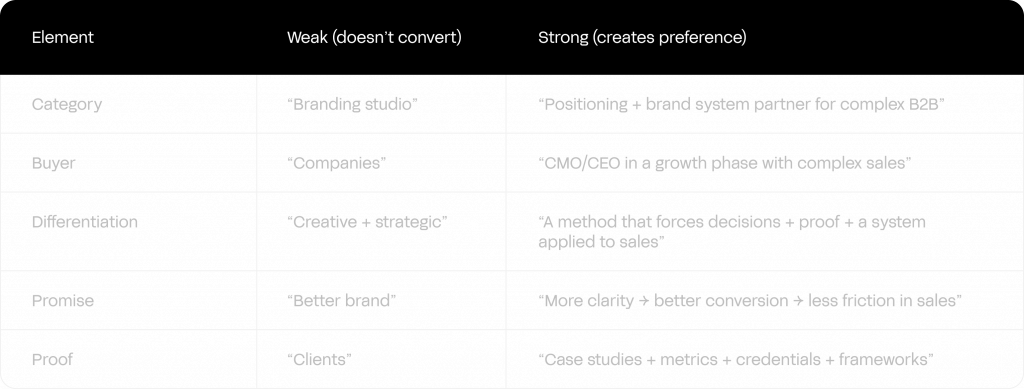
Weak vs. strong positioning (the comparison that matters)
Real proof (cases) — what “clarity” looks like in practice
So this doesn’t stay theoretical, here are three simplified examples of our work that show category + clarity + evidence:
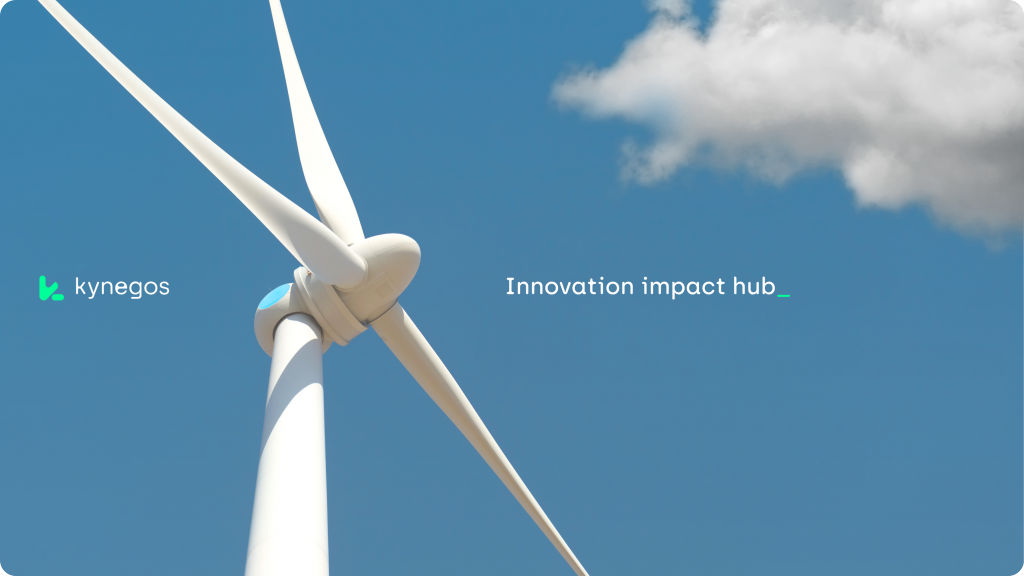
Kynegos — when you don’t fit any label, you dilute
In an ecosystem full of labels (consultancy, accelerator, fund…), Kynegos didn’t fit. The decision was to define a clear category: impact-focused, sustainability-driven company builder. From there, we built a brand system and a website designed to explain method, criteria, and role (not list services). Result: more clarity for communicating complexity and more credibility to activate collaborations.
GUA — from vendor to partner (when the market doesn’t perceive your authority)
GUA had experience and R&D, but expressed itself like a commodity. Repositioning: bio-intelligent partner. The real impact here isn’t “branding”—it’s that sales stops pushing features and starts selling from authority + direction.

Bright — when the tech noise wins… and you’re premium human value
Bright didn’t need to look like an AI startup. It needed its digital presence to reflect its true value. The category jump was “school” → Personal Language Trainers. Result: total clarity of the value proposition to defend a premium service against generic alternatives.

Note: if you want numbers, in many projects the most useful indicator isn’t “likes.” It’s sales friction: fewer back-and-forths on proposals, fewer “but what do you actually do?”, and fewer dead cycles caused by a weak narrative. In B2B SaaS, moving from “variable pitch” to a “consistent story” often cuts weeks off the cycle (and raises perceived value).
Examples by niche (how to land it without losing the substance)
This isn’t about writing “industry copy.” It’s about understanding what changes the risk and the proof.
B2B SaaS
- Category: “Positioning system for SaaS with long sales cycles”
- Proof: case studies by vertical, messaging for outbound/SDR, narrative for demo and sales.
Biotech / Life Sciences
- Category: “Brand that reduces uncertainty: evidence + credentials + narrative”
- Proof: advisory board, validations, publications, partners, compliance.
B2B Fintech
- Category: “Brand that translates risk and compliance into trust”
- Proof: security, regulation, integrations, cases, audits.
Tech startups (growth)
- Category: “From MVP to category: clarity + differentiation + pricing power”
- Proof: narrative for fundraising, ICP focus, a pilot/case with clear learning.
If you’re at the point where the market still describes you as “just another option,” you don’t lack energy. You lack decision (and proof). And that can be worked on.
At Salago, we approach positioning as an operating system (Brand OS): context → decisions → messaging → proof → applications. The goal isn’t “to sound better,” but to reduce sales friction and increase perceived value.
The sign that positioning is working isn’t that the website “looks good.” It’s that the team explains the same thing without contradictions, objections become more predictable, and the buyer understands the value earlier (and moves faster).
— Cristian Salazar
Creative Director, Salago®
FAQs About Brand Positioning Strategy
What is a brand positioning strategy?
A brand positioning strategy is the strategic decision that defines how a brand wants to be perceived in the market, which alternatives it competes against, who it serves, and what evidence supports its differentiation.
Why is brand positioning important in B2B?
Because B2B purchases involve financial, professional, and operational risk. Clear positioning reduces uncertainty, builds trust, and helps buyers understand why they should choose a particular solution.
What is the difference between branding and positioning?
Branding expresses the brand visually, verbally, and experientially. Positioning defines the underlying strategy: category, buyer, differentiation, value proposition, and reasons to believe.
How can you tell if a B2B brand has weak positioning?
Common signs include the website doesn’t clearly communicate value, sales teams improvise their pitch. leads compare mainly on price, sales cycles become longer, the market describes the company as interchangeable.
What should a brand positioning strategy include?
A clear category, a primary buyer, a specific value proposition, defensible differentiation, proof that builds trust, and a messaging system that works across website, sales, and marketing.
How does positioning shorten sales cycles?
When buyers quickly understand what you do, who you help, why you’re different, and what evidence supports your claims, there is less uncertainty, less friction, and fewer delays during the buying process.
What role does proof play in B2B positioning?
Proof transforms a promise into something credible. It can include case studies, metrics, credentials, proprietary frameworks, clients, partners, research, or evidence of methodology.
When should a company revisit its positioning?
When it enters a new market, launches a new vertical, needs to justify premium pricing, prepares for fundraising, experiences low conversion rates, or feels its offering is perceived as interchangeable.