
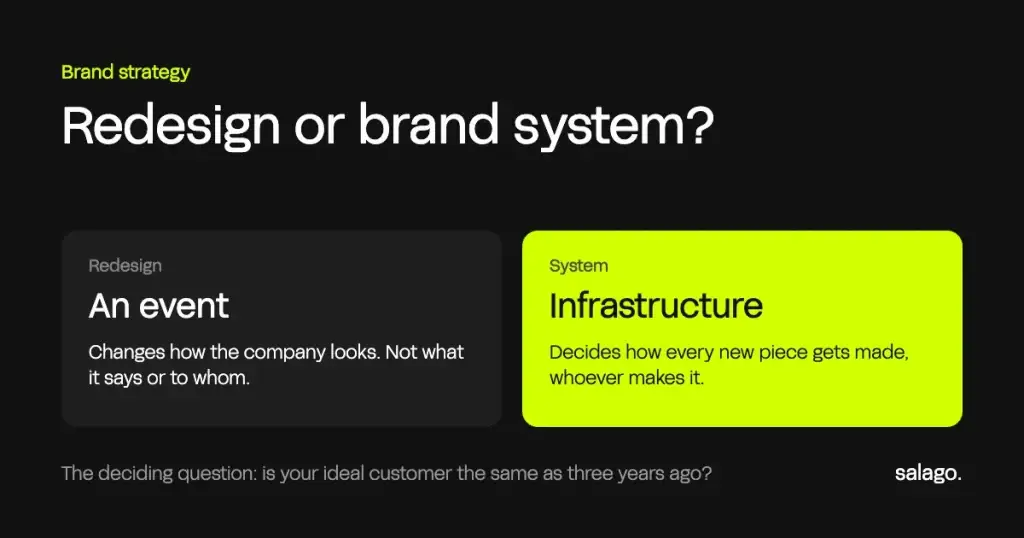
Quick answer. A redesign changes how a company looks; a brand system decides how every new piece gets made without starting from scratch. A redesign is an event; a system is infrastructure. If the brand looks dated but still tells the truth, a refresh is enough. If every brochure, web page or deck is argued over from zero, the problem is not aesthetic and a redesign will not fix it. One question separates the two cases: is your ideal customer today the same as three years ago? If the answer is no, the foundation (strategy and positioning) has to change before the surface does.
What is the difference between a refresh, a redesign, a rebrand and a brand system?
The four words are used as synonyms and they are not. Each one touches a different layer of the brand, costs a different order of magnitude and solves a different problem. Mixing them up is the most common way of paying twice for the same work.
| Intervention | What changes | When it makes sense | The signal that calls for it |
|---|---|---|---|
| Refresh | The surface: typography, colour, photography, templates | What the company says is still true, but it looks dated | “We’re embarrassed to show the website” |
| Redesign | The full visual identity: logo, graphic system, applications | The company has grown and the image has stayed small, with the same message | “We look smaller than we are” |
| Rebrand | The foundation: positioning, who it speaks to, what it promises; then the identity | The customer, the product or the market has changed | “What we say is no longer what we do” |
| Brand system | The rules: how each piece is decided, who can make it and what cannot be done | There are more people, markets or pieces than one person can oversee | “Every new piece needs a meeting” |
A brand system can accompany any of the other three, but it does not replace them. A rebrand without a system produces a new identity that degrades within a year; a system without strategy produces very clear rules for communicating something that has not been decided.
Why doesn’t a redesign fix a confusing brand?
A redesign changes how a company looks, not what it says or to whom. If the message was not decided before the redesign, after the redesign the company has the same confusing message in better typography. For a few months it seems to have worked, because everything is new; once the novelty wears off, the same symptoms return: decks that every salesperson rebuilds their own way, a website nobody knows how to update and pieces that do not look alike.
The most reliable sign that the problem was strategy and not design is that every new piece is still argued over from scratch. When a team needs a meeting to decide the headline of a brochure, what is missing is not a logo: it is a prior decision about what the company stands for, written down somewhere and accepted by whoever signs off.
A redesign can also break what was working
The risk of a redesign is not only spending without solving. It is destroying the elements customers already recognised. The most cited case is Tropicana in the United States: in January 2009 it changed the packaging of its Pure Premium juice and, according to IRI data published by Ad Age and Bloomberg, unit sales fell 20% between 1 January and 22 February, around 33 million dollars. The brand withdrew the new design in less than two months. The old pack was not prettier; it was the one people knew how to find on the shelf.
A brand system starts by taking inventory of those assets —the colour, the shape, the line the customer recognises— and decides which ones are protected. A redesign done without that inventory treats everything as replaceable.
How do you know whether you need a redesign or a system?
The deciding question is whether today’s ideal customer is the same as three years ago. If the company sells the same thing to the same person and only looks dated, the problem is on the surface and a refresh or a redesign solves it. If the customer has changed —it now sells to groups instead of distributors, to a technical director instead of procurement, to another country— the problem is in the foundation, and any visual change that does not start there falls short.
| Symptom | What the problem really is | What to buy |
|---|---|---|
| The website and materials look dated next to competitors | Surface | Refresh or redesign |
| Every salesperson explains the company differently | Positioning | Strategy before design |
| Every new piece needs a meeting to decide how it is made | System | Rules, templates and written criteria |
| The brand depends on one person (in-house designer or agency) for everything | System | A documented system others can apply |
| The ideal customer has changed in the last three years | Foundation | Rebrand: strategy, identity and system |
| Several product lines, brands or markets are about to launch | Architecture | Brand architecture and system |
The three rules of a brand system that works
The difference between a brand system and a style comes down to three conditions. If one fails, what you have is a style: something that looks good while its creator is applying it.
1. It is applied without asking
A brand system solves the great majority of pieces without the designer stepping in. If someone has to be called to decide how a data sheet is laid out or which photo goes in a deck, the system is not finished. The practical test: hand the guidelines to a new supplier and see whether the first thing they do is ask.
2. It has written limits
In a brand system, what cannot be done is worth more than what can. Guidelines that only show correct examples are broken in the first month, because nobody knows where the boundary is. A good manual says which colour combinations are forbidden, which tone is never used and what kind of image does not represent the company.
3. It outlives whoever made it
If the brand depends on one person, it is not infrastructure: it is a dependency. The test of a brand system is that someone who joins the company today can produce something recognisable tomorrow. It is the rule fewest brands meet and the one that costs most when it breaks, because it coincides with the in-house designer leaving or the agency changing.
How much does not having a brand system cost?
The cost of not having a brand system does not appear on any invoice: it is paid in decision hours. It is calculated like this:
Annual cost without a system = new pieces per year × hours of discussion per piece × people in the discussion × cost per hour.
An illustrative example, built on assumptions rather than client data: a company that produces 40 pieces a year (data sheets, decks, posts, trade-show stands), spends two hours of meetings on each among three people and has an average cost of 50 € per hour spends 12,000 € a year just deciding things a system would already have decided. Every company has to plug in its own numbers, but the formula almost always returns a bigger figure than expected.
One external data point points the same way. In a study published by Figma, designers working with a design system completed the same task 34% faster than without one. The study measures digital product design systems, not full brand systems, but the mechanism is the same: fewer repeated decisions, more time for the ones that matter.
The honest caveat: when you don’t need a system
Not every company needs a brand system. If one person produces all the materials, few pieces are made each year and there are no plans to grow the team, markets or product lines, a good redesign with a few basic templates is enough and a full system would be over-investment.
Nor does it make sense to start with the system if the positioning has not been decided. Very clear rules for communicating something confusing only make the confusion more consistent. In that case the right order is strategy first, then identity and the system last.
How much does each option cost at Salago?
These are the Salago programmes that match each intervention, with their prices and timelines. For market reference ranges, see our article on how much B2B branding costs.
| Programme | What it solves | Timeline | Price |
|---|---|---|---|
| Brand Audit | Diagnosis: finding out whether the problem is surface, foundation or system | 3-5 days | 2,500 €, deducted if a programme is then hired |
| Clarity | Strategy and positioning: the foundation a redesign does not touch | 2-3 weeks | 5,000 € |
| Identity | Strategy plus full visual and verbal identity | 6-8 weeks | From 15,000 € |
| System | Strategy, identity, brand system and launch (web, motion, 3D) | 3-4 months | From 35,000 € |
How we approach it at Salago
At Salago we do not start with design. We start by finding out which layer the problem is in: surface, positioning or system. That answer changes the budget by an order of magnitude and avoids the most expensive situation, which is doing a redesign when a rebrand was needed. That is why the starting point is usually a Brand Audit, and when the diagnosis confirms that the brand has to work without depending on anyone, the programme is System.
If your company is about to commission a redesign, ask us for the diagnosis first: within a week you will know what you are buying.
What to do on Monday
- Write down whether your ideal customer today is the same as three years ago.
- Count the pieces you have produced in the last twelve months and how many needed a meeting to decide how to make them.
- Apply the no-system cost formula with your own numbers.
- Ask three people on the team to explain in one sentence what the company does and compare the answers.
- List the elements of your brand that customers recognise and that should not be touched.
Frequently asked questions
A redesign changes the visual identity while keeping the same message and the same customer. A rebrand first changes the foundation, meaning the positioning, who the company speaks to and what it promises, and then the identity. If the ideal customer has changed, a redesign falls short.
A brand system is the set of rules that decides how every new piece of a company gets made: what can be done, what cannot, with which templates and with what criteria. Its goal is that anyone, inside or outside the company, can produce recognisable materials without having to ask.
There is no fixed interval. A brand is redesigned when its image no longer represents the size or ambition of the company, and rebuilt from the foundation when the customer, the product or the market changes. Redesigning on a calendar, without one of those reasons, usually destroys recognition without gaining anything.
It depends on whether only the surface is touched or the foundation too. At Salago, strategy and positioning (Clarity) costs 5,000 €, a full identity with strategy (Identity) starts at 15,000 € and a programme with brand system and launch (System) starts at 35,000 €.
Not always. Guidelines that only show correct examples are a style catalogue. They become a system when they include decision rules, written limits on what cannot be done and templates that other people can apply without the designer who created them.
Yes, if it removes the elements customers used to recognise the product. In 2009 Tropicana changed the packaging of its Pure Premium juice in the United States and, according to IRI data published by Ad Age, unit sales fell 20% in less than two months, until the brand brought back the previous design.
When one person produces all the materials, few pieces are made each year and there are no plans to grow the team, markets or products. Also when the positioning has not been decided: then you have to start with strategy, because a system only makes a confusing message more consistent.
In short
A redesign is an event that makes the company look good for a season; a brand system is the infrastructure that decides how the piece nobody foresaw gets made, two years later, by someone who was not there.
Before commissioning either, answer whether the ideal customer has changed. If it has, the work starts with strategy. If it has not, and what wears you down is that everything is argued from scratch, what is missing is the system.
And to know what not having one costs: pieces per year × hours of discussion per piece × people × cost per hour. If the result looks like the price of the system, the decision is made.
Keep reading: Brand positioning for B2B and how much a biotech rebrand costs.
Sources
- Bloomberg Businessweek. Tropicana Fiasco From Arnell is Gift That Keeps Giving. 2 April 2009 (citing Information Resources Inc. data published by Ad Age).
- Figma. Measuring the value of design systems.