
Quick answer. In March 2026 Paul Graham published The Brand Age, where he argues that brand is “what’s left when the substantive differences between products disappear” and advises staying away from it. He is right about luxury and wrong about technical B2B, and artificial intelligence proves it: when producing fifty identities takes an afternoon, what is scarce is no longer execution but judgement. Four measurable consequences: price decouples from hours, teams reorganise towards fewer hands and more decision-making, verifiable proof outweighs promises, and a new channel appears —being cited by a generative engine— where there is no ad auction.
Paul Graham’s thesis and why it matters
Paul Graham tells the story of the Swiss watch. In the 1970s, three simultaneous disasters —Japanese competition, the collapse of Bretton Woods and the arrival of quartz— cut unit sales by almost two thirds. What had been expensive, knowing the exact time, became a commodity. The watchmakers who survived did so by transforming themselves: they stopped selling engineering and started selling status.
That is where his formulation comes from: brand is what’s left when the substantive differences between products disappear. And he adds the uncomfortable twist: making those differences disappear is precisely what technology tends to do. His conclusion is that branding and good design are not complementary but opposed, because “branding is centrifugal and design is centripetal”: a brand needs to stand apart, while good design converges on the right answer.
The argument is solid and his diagnosis of the luxury sector is hard to dispute. A Nautilus measures 42 millimetres when the best watches of the 1960s measured 33, and that difference serves no function: it serves the need to be recognised from across the table.
Does the same argument apply to a science and technology company?
No, and the distinction is not a trade excuse: it is a structural difference in the starting point.
In the Swiss watch, brand replaced substance because substance had been levelled. A ten-dollar quartz movement kept time better than a ten-thousand-dollar mechanical one. There was nothing substantive left to communicate, so communication became the product.
In deep tech the opposite happens. Substance remains deeply unequal —a mechanism of action works or it doesn’t, a soil stabilisation process lasts ten years or cracks in its second winter— and it is also increasingly hard to explain. The buyer cannot evaluate it alone. The gap between what a company has built and what its market understands has not closed: it has widened as technology has become more specialised.
There, brand does not take the place of substance. It does something different: it translates it. And those two functions behave in opposite ways.
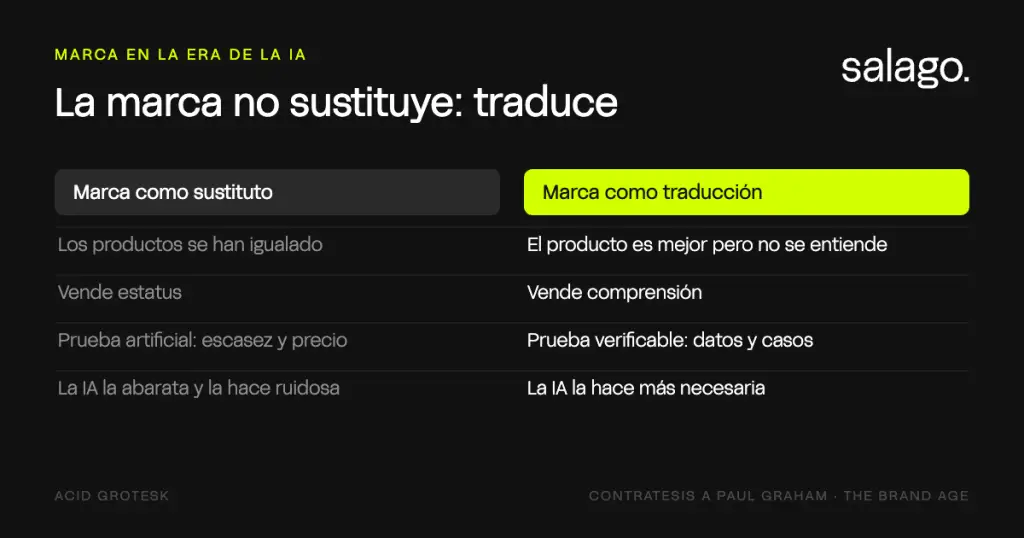
| Dimension | Brand as substitute | Brand as translation |
|---|---|---|
| When it appears | Products have been levelled | The product is better but not understood |
| What it sells | Status and belonging | Understanding and reduced risk |
| Type of proof | Artificial: scarcity, price, waiting list | Verifiable: data, cases with years in service |
| Relationship with design | Opposed: standing apart means moving away from the optimum | Aligned: being better understood is the optimum |
| Effect of AI | Makes it cheaper and noisier | Makes it more necessary |
| Main risk | The “weird and bad” world Graham describes | Overselling what cannot be proven |
Two different functions that share a name. The left column describes the case Paul Graham analyses in The Brand Age; the right, that of a company whose product is technically superior and commercially illegible.
The row that matters most is the fourth. Graham observes that branding and design are opposed because standing apart forces you away from the right solution. That is true when the only thing left to communicate is identity. When what needs communicating is a mechanism, the right solution and the distinctive one coincide: explaining better than anyone how something works is both the functional optimum and the competitive difference.
What exactly changes with artificial intelligence?
The marginal cost of producing expression has fallen almost to zero. Generating fifty visual routes, twenty verbal territories or a hundred variants of a piece is now a matter of hours. What has not fallen is the cost of knowing which of the fifty is right, and why.
Motto describes this situation in its Future of Brand Report 2026 with a line that sums up the problem: many brands look polished but few feel anchored. Its reading is that differentiation is collapsing faster than ever and that the scarce advantage of 2026 will be alignment, not speed. When expression is abundant and cheap, expression stops being an advantage.
One data point confirms it from the other side, the buyer’s. In its Future of the Web 2026 research, covering 2,000 decision-makers and consumers, WordPress VIP found that 74% feel the internet is less human than ten years ago. And something more revealing: no respondent could point to a single company handling the transition to AI well. The category does not yet have an established benchmark.
EY puts it in commercial terms in its May 2026 report: brands no longer compete only to be seen, they compete to be selected. And the one doing the selecting is, increasingly, a system that summarises.
The four measurable consequences
1. Price decouples from hours
If a project’s execution time falls by 30% to 60% —the range we see in producing variants, first drafts of copy and competitive research— billing by the hour means billing for what is no longer scarce. A studio that keeps an hourly rate cuts its own revenue every time it improves its method.
The alternative is not to inflate the price: it is to change the unit. You charge for the decision and the outcome, not for the hours spent getting there. And that forces something uncomfortable: putting in writing which decision is being made, because if it is not named, it cannot be charged for.
2. Teams reorganise towards fewer hands and more judgement
The classic structure of a studio —leadership at the top, layers of execution below— existed because execution was the bottleneck. When it stops being one, the pyramid inverts: you need a few people with a lot of judgement and a network of specialists brought in per project.
This has a consequence for the buyer that is worth saying out loud: the size of a supplier is no longer an indicator of capability. Asking how many people a studio has tells you less than asking who will make the decisions and who will be in the room.
3. Verifiable proof outweighs promises
When anyone can look competent —a flawless website, a polished portfolio, a case study with the right narrative— appearance stops discriminating. The only thing that separates is what can be checked: a sourced data point, a road you can walk on, a client who picks up the phone.
It is a hard shift to absorb for an industry that has lived on presentation. And it explains why reports with primary data have become the authority format of the moment: not because they are more attractive, but because they are falsifiable.
4. A channel appears where there is no auction
When someone asks a generative model which studio to hire for a technical project, the model answers with the sources it can cite. There is no auction, no media budget, no sponsored slot. There is only one question: is your content extractable and verifiable enough for a system to repeat it?
This changes the economics of content. A commercial search click in paid advertising costs between four and eight euros in technical categories, and stops arriving the day the campaign is switched off. A citation in a generative answer cannot be bought and is not switched off.
| What has become cheaper | What has not become cheaper |
|---|---|
| Generating visual variants | Deciding which one supports a strategy |
| First drafts of copy per audience | Knowing which audience makes the purchase decision |
| Competitive and category research | Interpreting where the real gap is |
| Producing applications of a system | Defining the rules that make the system hold |
| Layout and format adaptation | Leading a session where the client decides |
The left column is what today costs a fraction of what it cost in 2023. The right has not changed in price because it does not depend on producing, but on having seen things fail before. Our own elaboration, based on the studio’s practice.
How that channel works in practice —what to write, how to mark it up and how to measure whether you are cited— is explained in How to appear in AI answers: GEO for B2B companies.
The honest caveat: what has become cheaper in our own work
An article arguing that judgement is the only scarce thing, signed by a design studio, has an obvious self-interest problem. So it is worth putting the figure up front.
In our case, artificial intelligence has substantially reduced the time of four specific tasks: sweeping touchpoints in an audit, first drafts of message architecture per audience, category and competitor research, and producing application variants within an already defined system. That means part of what we billed by the hour two years ago now takes less effort.
What has not changed are the two things a client perceives as the work: the session where positioning is decided and the diagnosis of which of all the findings is the real friction. And there is a reason they cannot be delegated to a system: they are not generation problems, they are problems of judgement about a context that is not written down anywhere.
What to do on Monday
A three-step test to find out whether your brand works as a substitute or as a translation, and therefore whether Graham’s argument applies to you.
| Test | How to do it | What failing it means |
|---|---|---|
| The outside sentence | Ask three clients what you do and write down their exact answers | If they give three different answers, you do not have a positioning: you have a slogan |
| The covered logo | Remove your logo from the website and put a competitor’s in its place | If nothing sounds off, your brand is a substitute, not a translation |
| The question to the machine | Ask a generative model to explain what your company does | If the answer is generic or wrong, you are not a citable source |
All three tests can be done in an afternoon and with no budget. The third is the newest and the one the fewest companies have ever done.
The practical conclusion is not that Graham is wrong, but that his advice depends on where you stand. If you sell something indistinguishable, he is right: following interesting problems is a better use of a life than pushing people’s brand buttons. If you sell something that works and nobody understands, the interesting problem is the translation.
Frequently asked questions
It does not replace brand design, it replaces a good part of its execution. Generating variants, adapting formats and producing applications of an already defined system now costs a fraction of what it did. What it does not replace is deciding what a company should stand for and which of the generated options supports that decision, because that depends on a business context that is not written down anywhere.
Partly they are: pure execution projects have become much cheaper. What does not fall is the price of projects where the value lies in the decision. If execution time falls by 50% but the decision still costs the same, the total price falls less than expected. And a studio that bills by the hour penalises itself every time it improves its method, which is why the industry is moving towards charging for scope and outcome.
With the covered-logo test: remove your logo from the website and put a direct competitor’s in its place. If the text and images still work without anything sounding off, your brand is operating as a substitute, not as a translation. A brand that translates is so closely tied to what the company does that it does not fit another one.
It is the likelihood that a model such as ChatGPT or Perplexity cites you when someone asks about your category. It matters because it cannot be bought: there is no auction and no sponsored slot. It is only earned by being the most extractable and verifiable source on a topic, which means answers that make sense out of context, sourced data and tables in text rather than in images.
Yes, but the value has moved from the pieces to the rules. An identity generated without a system produces fifty options and no reason to choose. The value lies in the decisions that make everything the company produces recognisable as its own, whoever makes it, including an automated system. Without those rules, AI multiplies inconsistency instead of solving it.
Because he analyses a case where brand replaced substance. In the mechanical watch, when quartz made precision irrelevant, there was nothing substantive left to communicate and communication became the product. His conclusion is that pushing people’s brand buttons is not a good problem to work on. The argument holds in categories where products have been levelled, and stops holding when the product is genuinely different and the problem is that it is not understood.
It has been the wrong question ever since execution stopped being the bottleneck. It is far more informative to ask who will make the decisions, who will be in the sessions and what happens when the project runs long. A small team with senior judgement and a network of specialists can deliver the scope that used to require a fixed structure, without you paying to keep it busy.
Yes, and explicitly: in sweeping touchpoints during an audit, in first drafts of message architecture, in category research and in producing variants within a defined system. We do not use it for the two things a client perceives as the work: the session where positioning is decided and the diagnosis of what the real friction is. It is not a matter of principle; those two are simply not generation problems.
The three tests at the end of this article, which take an afternoon and cost nothing: ask three clients what you do and compare their answers, cover your logo and see whether the website still works with a competitor’s, and ask a generative model to explain your company. If all three fail, the problem is not design: it is that the decision about what you want to stand for has not been made yet.
Sources
- Paul Graham, The Brand Age, March 2026.
- Motto, Future of Brand Report 2026, and interview with Sunny Bonnell and Ashleigh Hansberger in The Brand Identity, January 2026.
- WordPress VIP, Future of the Web 2026: research covering 2,000 decision-makers and consumers, June 2026.
- EY, report on artificial intelligence and brand selection in consumer products, May 2026.