
Do your users influence the purchase decision, or do they remain at the initial stage of wanting something, without any further authority to make a decision? How do you distinguish between them? In the end… who’s in charge? Buyers and users: Often, they are different people with different motivations, expectations, and goals. If you have them clearly defined, it will be easier to chart the course toward your objectives.
When faced with a problem or need, we evaluate the various solutions presented through a single lens, according to our urgency, motivations, or concerns. Delving into the motivations of users and buyers is essential, whether for building brand narratives or marketing campaigns.
To arrive at these insights, we can construct more or less realistic archetypes, focusing on usage (User/Design Personas) or on purchase (Buyer/Marketing Personas), which will help us keep our eye on the final recipient of the work.
Don’t confuse buyers and users, unless… the two roles end up merging into the same person.
Buyer Personas, orbiting the planet Marketing
Buyer Personas are, ultimately, the ones who make the purchasing decision. Even if they aren’t users, they are part of the target market we want to reach. As a tool, we use them to guide our campaigns, ensuring we speak to the right audience, in their language, on the right channels, and with the most appropriate messages.
Buyer Personas can be individuals or an entire team. They make high-level decisions and consider goals and expectations critical factors. To build them, we need to know (or determine) their demographic and psychographic characteristics, consumption habits, goals, and challenges—no small feat.
What does all that mean? Age, gender, location, occupation and income range, values, preferences, attitudes, and brand affiliations; what brands and media they consume, on which channels, how often; what their goals are in relation to your product or service; and how you will solve (or better solve) the problems or pain points they currently face.
Buyer Personas are ideal for…
• Defining our marketing objectives internally.
• Segmenting the market we want to target.
• Building our value proposition message.
• Opening communication to new customers.
And Buyer Personas won’t help you if what you need is…
• Defining your product’s personality.
• Deciding what features it should have.
• Prioritizing your development needs at different stages.
• Discovering how the product will be used over time.
Design Personas, the User Constellation
If Persona building in marketing focuses on WHO, a Design Persona focuses on HOW. Design Personas help us understand the context of those who use our product or service directly and intensively, delving into its ease of use, the skills required, the learning curve, previous experiences, and expectations.
Design Personas focus on micro-moments where a particular user tries to achieve a specific goal. They contain all the information present in Buyer Personas, but also additional information about user behavior, such as the path they take to achieve their goal, affinity patterns, and what stimuli influence their decision-making and how.
“Having a persona is no substitute for user research with actual users.”
Chris Thelwell | Are personas ruining your product?
They will serve as the internal reference point when discussing the overall vision of our product or service, reminding us that, in reality, those who use it (not us) are its owners. They offer us a realistic and objective view of where the problems lie. Problems solved? Better reviews, more word-of-mouth, more sales.
Design Personas are created to…
• Define the features the product or service should have.
• Identify realistic use cases.
• Decide how the interface will behave.
• Refine the appearance of our product or service.
So they won’t help us when it comes to…
• Defining acquisition strategies.
• Defining our external communication.
• Creating final sales materials.
How to Build Design/User Personas
These are models (conceptual representations) of what our audience is like, so we’ll need to research and define their objectives, desires, and behavior. You’ll have to delve into their goals, the context in which they live, their age and gender, their needs, and their fears.
The Essentials:
– You’ll need a profile picture, first and last name, age, gender, where they live, number of children, archetype, a brief biography, and a personality map.
– Images related to their lifestyle.
– Personality: Introverted or extroverted? Analytical or creative? Passive or active? You can approach this point from different perspectives: Myers-Briggs, descriptions, or an axis diagram.
– Goals and motivations
(related to your product or service).
– Create final sales materials.
To polish it:
– Create 3 to 5 personas.
– Pay special attention to the products in your sector that are already being used.
– Reflect the customer journey of each of your personas (dropouts, bounces, where they get stuck, what motivates them, etc.).
– Highlight their differences.
– Reflect a typical day on a timeline.
– Include goals that your product can help them achieve, even indirectly.
– Review the media they use, from social networks to websites or browsers.
– Add real testimonials.
– Consider their favorite brands, books, movies, and music.
– Find a common metric to compare the behavior of your different personas.
– Ensure a consistent design.
– Use iconography to emphasize information.
– Give care to the data visualization. And remember, behaviors, attitudes, opinions, and motivations are what make our Personas human.
“Your target users’ pain points should influence your design decisions more than anything else.”
Tony Ho Tran | 5 essentials for your user persona template
Delving deeper into your Design Personas will allow you to develop materials such as…
• A Requirements document for your product or service, essential for the design team, but also for marketing, sales, or development. It describes its purpose, functionalities, and features.
• Information architecture. By understanding the users’ mental model, you can distribute information based on how they classify and navigate content.
• A style guide. You’ll know which colors, fonts, and visual worlds will resonate with your audience. You’ll ensure that your brand and style appeal to your target users.
• A content strategy. Tone of voice and style. You’ll have a clearer understanding of what type of content to create and where to distribute it.
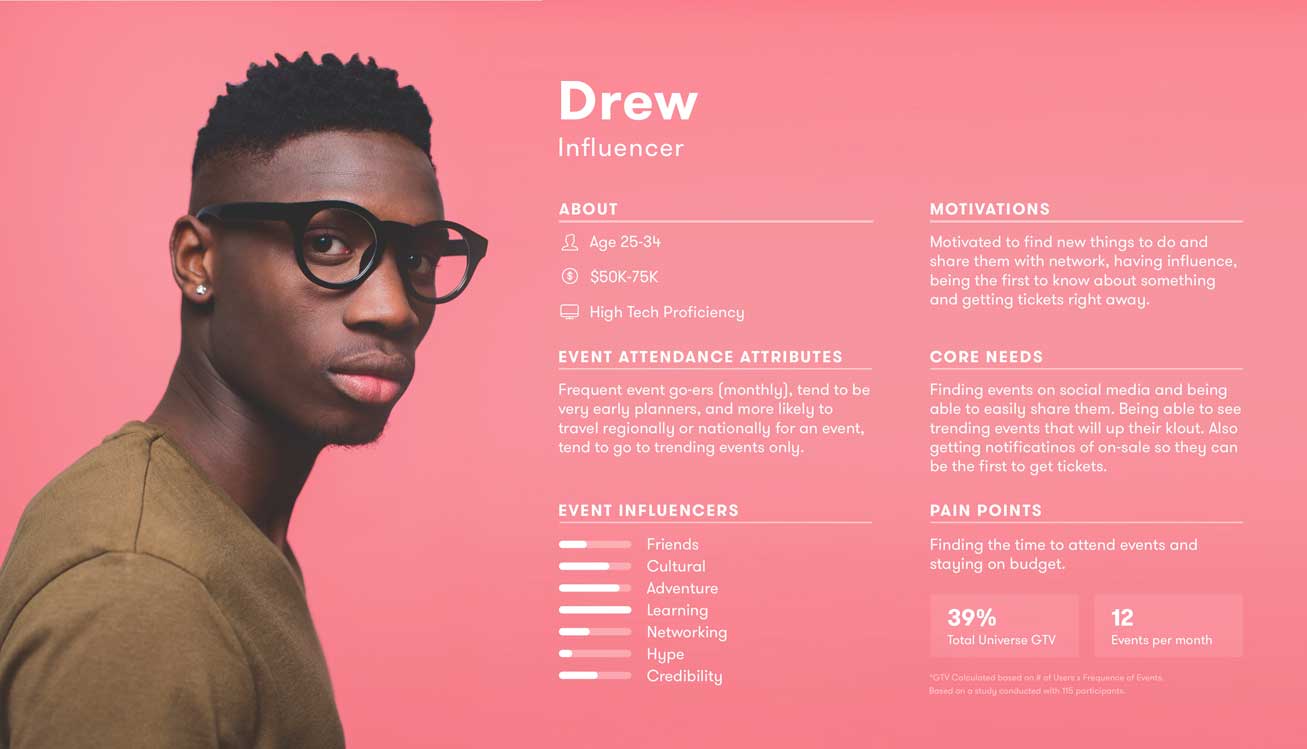
Here are some examples, in case you want to get started.
Drew The Influencer , de Arthur Chayka.
Nerdy Nina, de CTRL Metrics.
Mailchimp Personas, de Justin Pervorse.
The Aviator Analyst, de Applied by Design.
Are you having trouble? Do you want to download your Design Personas but you’re short on time?
Do you have all the information but… no desire to start on the design? Just whistle and we’ll help you; at Salago, we know a thing or two about people.